Reviewed September 26, 2026. Research-based review of Stacker's official pricing and positioning — not a hands-on benchmark. Jet Admin publishes this comparison and is a competing product.
If you are researching Stacker because you read about it as a no-code portal builder over Airtable, the most useful thing this review can tell you is that the product has changed. The domain moved from stackerhq.com to stacker.ai, and the positioning is now built around AI agents with credit-based pricing rather than per-seat portal plans.
Older reviews still describe the previous product. That mismatch matters more than any feature comparison, so this review leads with it.
Stacker review: the quick verdict
| Strong reasons to consider Stacker | Trade-offs to evaluate |
|---|---|
| No per-seat charges — unusual in this category | The product has repositioned; most published reviews describe the older version |
| Unlimited agents and unlimited customer portals on the paid plan | Credit-based pricing makes monthly cost harder to predict |
| 2,000+ integrations listed | Actions cost 1–50 credits, a 50× range |
| Entry price of $50/month is competitive | Scaling to 10,000 credits reaches $2,000/month |
No numerical score is given, because we did not run a scored hands-on evaluation.
What is Stacker now?
Stacker presents itself as an AI agent platform. The paid plan advertises unlimited agents, unlimited customer portals, and more than 2,000 integrations, metered by credits rather than by users.
The portal capability is still there — "unlimited customer portals" is on the plan. What has changed is the centre of gravity: agents and credits are the primary framing, and seats are not charged at all.
Why this matters for your research. If you found Stacker on a "best Airtable portal builders" list written before the repositioning, verify each feature you are counting on directly rather than trusting the list. The same caution applies to the Coda-to-Superhuman rebrand and to Glide's split into two products: in each case, secondary sources lag the change by months.
Stacker's key features
1. No per-seat charges
This is Stacker's most distinctive commercial decision and worth naming plainly: the pricing page states no per-seat charges. In a category where seat metering is the norm and the most common source of surprise bills, that is a real structural advantage.
2. Unlimited agents and portals
The Standard plan lists unlimited agents and unlimited customer portals. The constraint is credits, not object counts.
3. Credit-based metering
Work is measured in credits, with actions costing between 1 and 50 credits depending on what they do. Standard includes 250 credits, scaling up to 10,000.
4. A large integration catalogue
More than 2,000 integrations are advertised — high for this category, and consistent with an agent platform that needs to reach many systems.
Stacker pros
Seat-free pricing removes the most common no-code cost trap
Across this review series, the single most frequent complaint about no-code platforms is per-user pricing that scales badly. Stacker has removed that axis entirely. If your constraint is headcount, this is a genuine advantage.
A low entry point for an agent platform
$50 a month for unlimited agents and portals compares well against agent platforms that charge per workflow or per seat.
Unlimited portals suits agencies
If you serve many clients, unlimited portals plus no seat charges is a structurally friendly combination — provided credit consumption stays predictable.
Stacker cons and limitations
The repositioning makes secondary research unreliable
Reviews, comparison tables and tutorials written for stackerhq.com may describe features, plans and limits that no longer apply.
What to do: treat stacker.ai's own pricing and documentation as the only current source, and re-verify anything you read elsewhere.
Credit pricing is hard to forecast
Actions cost between 1 and 50 credits. A 50× spread means 250 credits could represent 250 simple actions or five complex ones, and you cannot tell which until you know your own action mix.
What to do: run a representative sample of your real work on the entry plan and measure credit burn before committing. This is the same discipline required for Lovable, Base44 and every other credit-metered tool in this series — the pricing page cannot answer it for you.
The top of the published range is steep
10,000 credits at $2,000 a month is a 40× price increase over Standard for a 40× credit increase — linear, but a significant absolute figure, and it arrives quickly if your actions sit at the expensive end.
"Early bird" pricing may not persist
The $50 Standard plan is labelled "Early bird." Introductory pricing is not a commitment; factor in that it may change.
What do Stacker users say?
We are not citing a current aggregate rating. Published ratings for Stacker were accumulated against the previous product and positioning, and attributing them to the current platform would mislead more than it informs.
This is a real gap in the evidence, and worth stating rather than papering over: if user sentiment on the current product matters to your decision, ask Stacker for reference customers using the platform as it exists now.
Stacker pricing in 2026
Read from stacker.ai on September 26, 2026. USD. For a wider view of how Stacker's credit model compares with other platforms in this space, see our Stacker alternatives and pricing guide.
| Plan | Price | Credits | Seats | Agents and portals |
|---|---|---|---|---|
| Standard | $50/month — labelled "Early bird" | 250 | No per-seat charges | Unlimited |
| Standard, scaled | Up to $2,000/month | Up to 10,000 | No per-seat charges | Unlimited |
| Enterprise | Custom | Custom | No per-seat charges | Unlimited |
Actions consume 1–50 credits each.
An illustrative range, not a quote. If your typical action costs 5 credits, 250 credits is about 50 actions a month — low for an operational tool. If it costs 1 credit, it is 250. If it costs 50, it is five. Until you measure your own mix, the plan you need is unknown within a factor of fifty. That uncertainty is the main thing to resolve in a trial.
Jet Admin vs. Stacker: which should you evaluate?
| Priority | What to evaluate |
|---|---|
| Avoiding per-seat costs | Both: Stacker charges no seat fees; Jet Admin includes unlimited users on every plan |
| Predictable monthly cost | Jet Admin's plans are flat. Stacker's credits vary with action mix |
| AI agents as the primary use case | Stacker is built around this now |
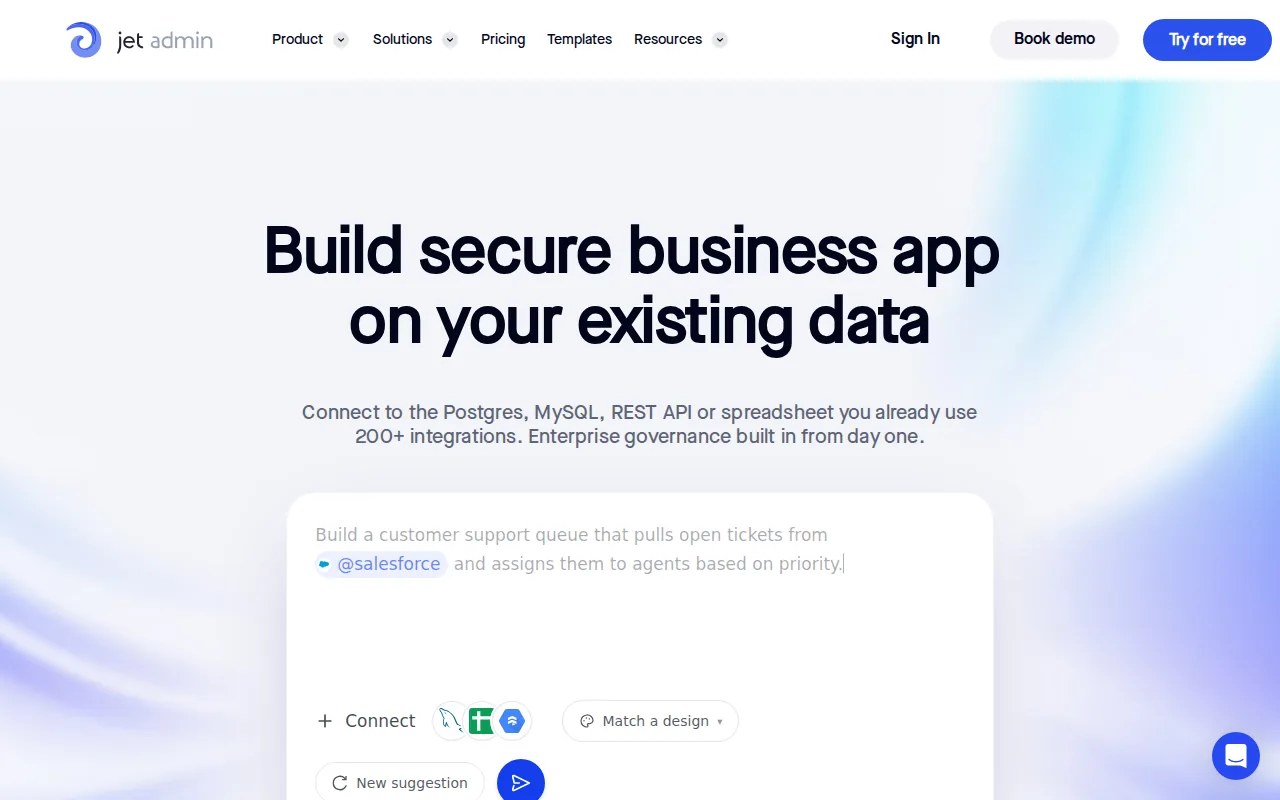
| Internal tools and admin panels over your own database | Jet Admin connects directly to Postgres, MySQL and APIs |
| Breadth of integrations | Stacker advertises 2,000+ — verify the specific ones you need |
| Stable, well-documented product surface | Consider that Stacker has recently repositioned |
Sources: stacker.ai, Jet Admin pricing, checked September 26, 2026.
Who should use Stacker — and who should compare alternatives?
Good fit: teams whose primary goal is deploying AI agents; organisations with many users where seat-free pricing is decisive; agencies needing many portals without per-client seat costs.
Compare alternatives if: you need a predictable monthly bill; your use case is a conventional internal tool or admin panel rather than agents; you were specifically looking for the older Stacker portal product; or you need current user references before committing.
If what you actually wanted was a portal or internal tool over your existing data, with flat pricing and unlimited users, build it in Jet Admin and compare.
Stacker review FAQ
Is Stacker still a no-code portal builder?
Portals are still on the plan — unlimited customer portals are listed — but the product now presents primarily as an AI agent platform at stacker.ai. Reviews describing the earlier stackerhq.com product may be out of date.
How much does Stacker cost?
Standard starts at $50 a month with 250 credits, labelled "Early bird" pricing, scaling to $2,000 a month for 10,000 credits. Enterprise is custom.
Does Stacker charge per user?
No. The pricing page states no per-seat charges, which is unusual in this category.
How many credits will I use?
Actions cost 1 to 50 credits each, so the answer depends entirely on your action mix. Measure on the entry plan before committing to a tier.
Does Stacker have a free plan?
No free tier is listed on the current pricing page.
How does Stacker compare with Jet Admin?
Both avoid per-seat pricing. Stacker is now oriented toward AI agents with credit metering; Jet Admin builds internal tools and portals over your own databases and APIs on flat plans.
Verify before you compare
The most valuable step in evaluating Stacker in 2026 is confirming what the product is today rather than what it was. Check stacker.ai directly, run your real actions against the credit meter, and discount any third-party review that still says stackerhq.com.
If flat, predictable pricing over your own data matters more than agents, try Jet Admin alongside it.