Reviewed September 26, 2026. Research-based review of v0's official pricing — not a hands-on benchmark. Jet Admin publishes this comparison and is a competing product.
v0 is Vercel’s AI application builder. It generates interface code and supports full-stack applications with server routes, databases, and authentication integrations; production use requires engineering validation.
Pricing is credit-based, and the structure is unusual — on Plus, your $30 subscription includes $30 of credits, so you are largely prepaying for usage rather than paying a platform fee on top.
v0 review: the quick verdict
| Strong reasons to consider v0 | Trade-offs to evaluate |
|---|---|
| Generates real React and Next.js code, not a proprietary format | Full-stack generation supported; validate backend configuration and authorization |
| Backed by Vercel, with deployment in the same ecosystem | Credit-based usage is hard to forecast |
| Plus subscription is effectively prepaid credits | Free includes $5 in one-time credits for new users |
| Free tier available for evaluation | Output is a starting point that needs engineering review |
No numerical score is given, because we did not run a scored hands-on evaluation.
What is v0?
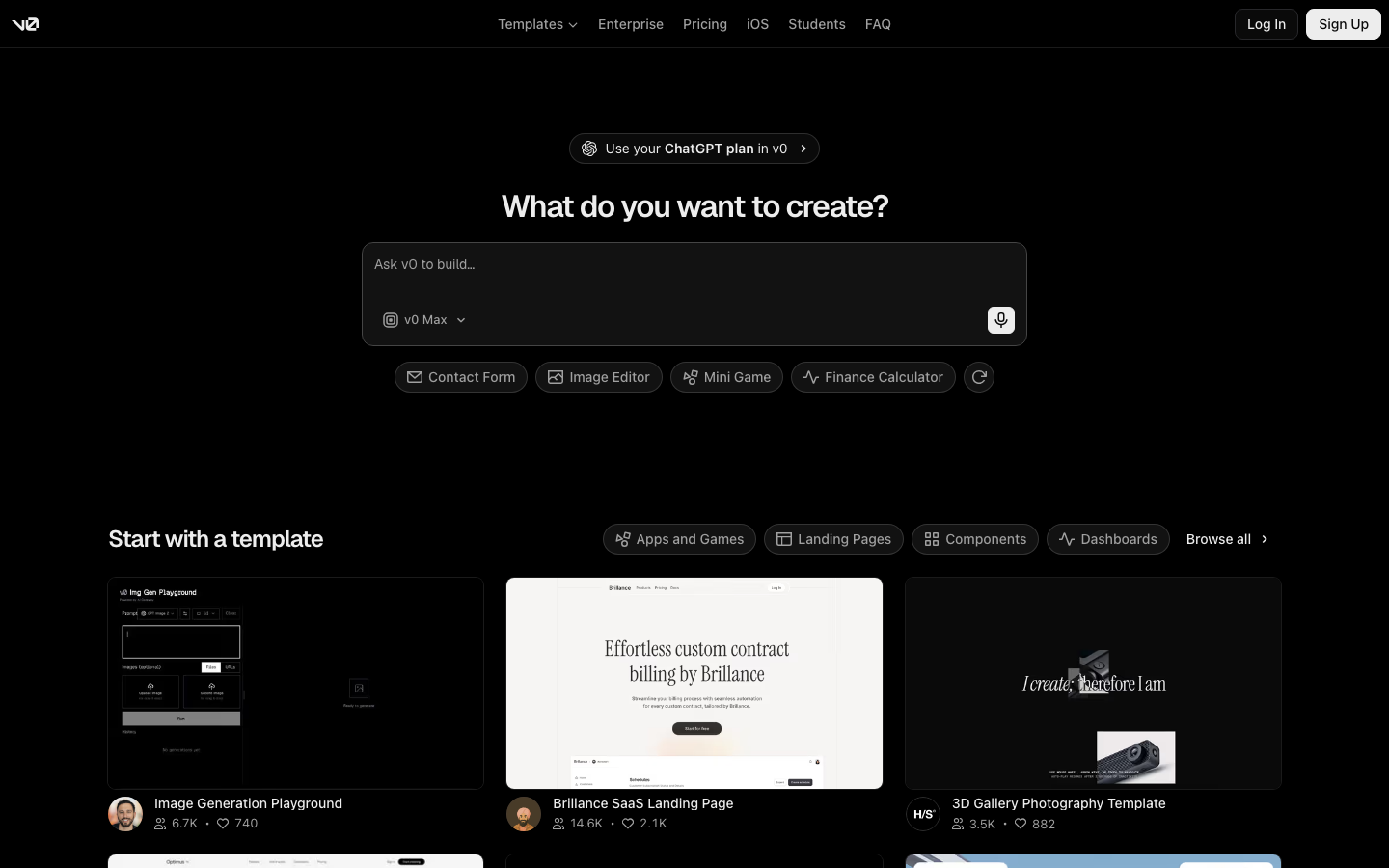
v0 turns natural-language prompts into React and Next.js interface code. It sits in Vercel's ecosystem, which means generated work moves toward Vercel deployment naturally.
What it is not: a platform that runs your application. There is no included database, no authentication layer, no backend logic. You get code — which is genuinely valuable, and genuinely incomplete.
v0's key features
1. Prompt-to-interface generation
The core capability: describe a screen or component and receive working React or Next.js code.
2. Standard framework output
Because v0 emits React and Next.js rather than a proprietary format, its output is code your developers already know how to read, review and maintain. That is a meaningful difference from visual builders whose output only runs inside their own runtime.
3. Vercel integration
Being a Vercel product, deployment is a short step rather than an integration project — if you are already on Vercel.
4. Credit-metered usage
Free includes $5 in one-time credits for new users. Plus is $30 and Business $100 per user monthly; both list $30 monthly credits and $2 daily credits on login. Enterprise is custom.
v0 pros
The output is ordinary code
This is v0's strongest structural advantage. React and Next.js are widely understood; a developer can read what v0 produced, correct it, and own it. Compare that with generated apps locked to a vendor runtime, and the difference in long-term risk is large.
Subscription and credits are the same money
On Plus, $30 buys $30 of credits. There is no separate platform fee stacked on top of usage — an honest structure, and rarer than it should be.
Speed on the specific job it does
For scaffolding interfaces — dashboards, forms, layouts — starting from generated code rather than a blank file saves real time.
A free tier that lets you judge quality
Seven messages a day is limited, but enough to see whether the generated code meets your standards before paying.
v0 cons and limitations
Validate the backend and authorization
No database, no authentication, no server logic. Building a working application with v0 means building or buying everything behind the interface.
Who it affects: anyone expecting an end-to-end app builder. What to do: plan the backend explicitly — Supabase, your own API, or an engineering sprint — and budget for it separately.
Credit consumption is unpredictable
Credits are consumed by generation, and complex prompts cost more than simple ones. $30 a month may cover a project or a week of it.
What to do: spend the free $5 on prompts representative of your real work and extrapolate before subscribing.
Generated code needs review
AI-generated interfaces are drafts. Accessibility, state management, error handling and performance all warrant a developer pass. Treating v0 output as production-ready is the most common way teams get burned by tools in this class.
The free tier's daily cap limits iteration
Seven messages a day makes the iterative refinement that AI builders reward difficult on Free. It is an evaluation tier, not a working one.
What do v0 users say?
We did not verify a current aggregate rating on G2 or Capterra for v0, so no score is cited here. The details above come from v0's own pricing page.
If peer sentiment matters to your decision, check those sources directly — and weigh how recent the reviews are, since tools in this category change substantially within months.
v0 pricing in 2026
Read from v0's pricing page on September 26, 2026. USD.
| Plan | Price | Credits | Notable limits |
|---|---|---|---|
| Free | $0 | $5 one-time credits for new users | Check current account limits |
| Plus | $30/month | $30 per user, plus $2 daily | — |
| Business | $100/month | $30 monthly plus $2 daily on login per user | — |
| Enterprise | Custom | Custom | — |
Worth confirming directly: whether the $2 daily allowance accumulates or resets each day materially changes the effective value of Plus, and the pricing page does not settle it.
Jet Admin vs. v0: which should you evaluate?
These tools solve different problems, so this is less a comparison than a routing decision.
| Priority | What to evaluate |
|---|---|
| React or Next.js code you own and can maintain | v0 — this is its purpose |
| A working internal tool without building a backend | Jet Admin connects to your database and API directly |
| Already deployed on Vercel | v0 fits the existing pipeline |
| No front-end engineering capacity | Validate Jet Admin configuration, permissions, and workflow behavior |
| Predictable monthly cost | Jet Admin is flat; v0 is credit-metered |
| Unlimited users on the finished tool | Jet Admin includes them on every plan |
Sources: v0 pricing, Jet Admin pricing, checked September 26, 2026.
When v0 is the better choice
If you have developers and want to accelerate them rather than replace their tooling, v0 is the right kind of tool and Jet Admin is not a substitute. Generated React that your team owns outright is a legitimate goal, and no comparison table should argue you out of it.
Who should use v0 — and who should compare alternatives?
Good fit: teams with front-end developers; projects already on Vercel; anyone wanting standard framework code rather than platform-locked output; rapid interface prototyping.
Compare alternatives if: you need a complete working application including data and auth; you have no engineering capacity to review generated code; you want predictable monthly costs; or your goal is an internal tool over an existing database.
If what you need is the finished tool rather than the code for it, build it in Jet Admin and compare.
v0 review FAQ
What does v0 do?
It generates React and Next.js interface code from natural-language prompts. It is Vercel's AI interface builder.
How much does v0 cost?
Free includes $5 one-time credits for new users; Plus is $30 and Business $100 per user monthly. Both list $30 monthly credits plus $2 daily on login; Enterprise is custom.
Does v0 include a backend?
Yes. v0 supports full-stack applications, including server routes, database integrations, and authentication workflows. Validate generated logic and configure connected services appropriately.
Can I use v0's code outside Vercel?
The output is standard React and Next.js, so it is not tied to a proprietary runtime — though deployment is smoothest within Vercel's ecosystem.
Is v0's generated code production-ready?
Treat it as a strong starting point. Accessibility, state handling and error cases warrant a developer review before shipping.
How does v0 compare with Jet Admin?
v0 generates code for developers to own; Jet Admin builds and runs the working tool over your existing data with unlimited users. Whether you want code or a finished application decides it.
Evaluate v0 as a full-stack builder
The official full-stack guide covers backend logic, API routes, database integrations, authentication, and CRUD workflows. Frontend-only descriptions no longer represent its scope. The decision is whether the generated application meets your data, authorization, deployment, and maintenance requirements.
Build a service-request app where customers submit requests, staff assign them, and managers view totals. Ask for the schema and server routes before polishing the dashboard. Sign in as two customers and try reading or changing the other customer’s record through the server endpoint. A hidden button is not evidence of server-side authorization.
The current pricing page lists $5 in one-time credits for new Free users. Plus is $30 per user monthly and Business $100 per user monthly; both list $30 monthly credits and $2 daily credits on login. Compare collaboration and governance features rather than assuming Business provides proportionately more included model usage.
| Check | What to exercise | Evidence to retain |
|---|---|---|
| Authorization | Call a route with another customer’s record identifier. | Denied access without leaked data. |
| Integrity | Submit twice and interrupt a save. | Defined duplicate handling and a consistent result. |
| Handoff | Clone and deploy through the intended source workflow. | Working configuration and documented ownership. |
Measure generation, repair, and ongoing operation
Use prompts representative of your actual application. Record the selected model, initial generation credits, and credits spent fixing authentication or deployment problems. Repeated context in a larger codebase can cost differently from an isolated component.
Separate generation credits from hosting, database, authentication, and connected APIs. A successful preview does not show that all of these costs are included in the builder subscription. Retain the selected service plans and expected workload with the estimate.
Have the future maintainer review generated routes, dependencies, secrets, and recovery steps. Ask them to change one business rule without help from the original author. Choose v0 when its standard code and supported integrations fit that team’s development process, and when the resulting application survives these checks.
Decide whether you want code or an application
v0 supports full-stack generation. Compare backend integration, authorization, hosting, and maintenance rather than treating it as frontend-only.
If the finished internal tool is the actual goal, try Jet Admin on the same requirement.