Lovable pricing looks straightforward until you start building. This guide breaks down the credit system, plan tiers, real cost drivers, and when a different tool makes more sense.
Key Takeaways
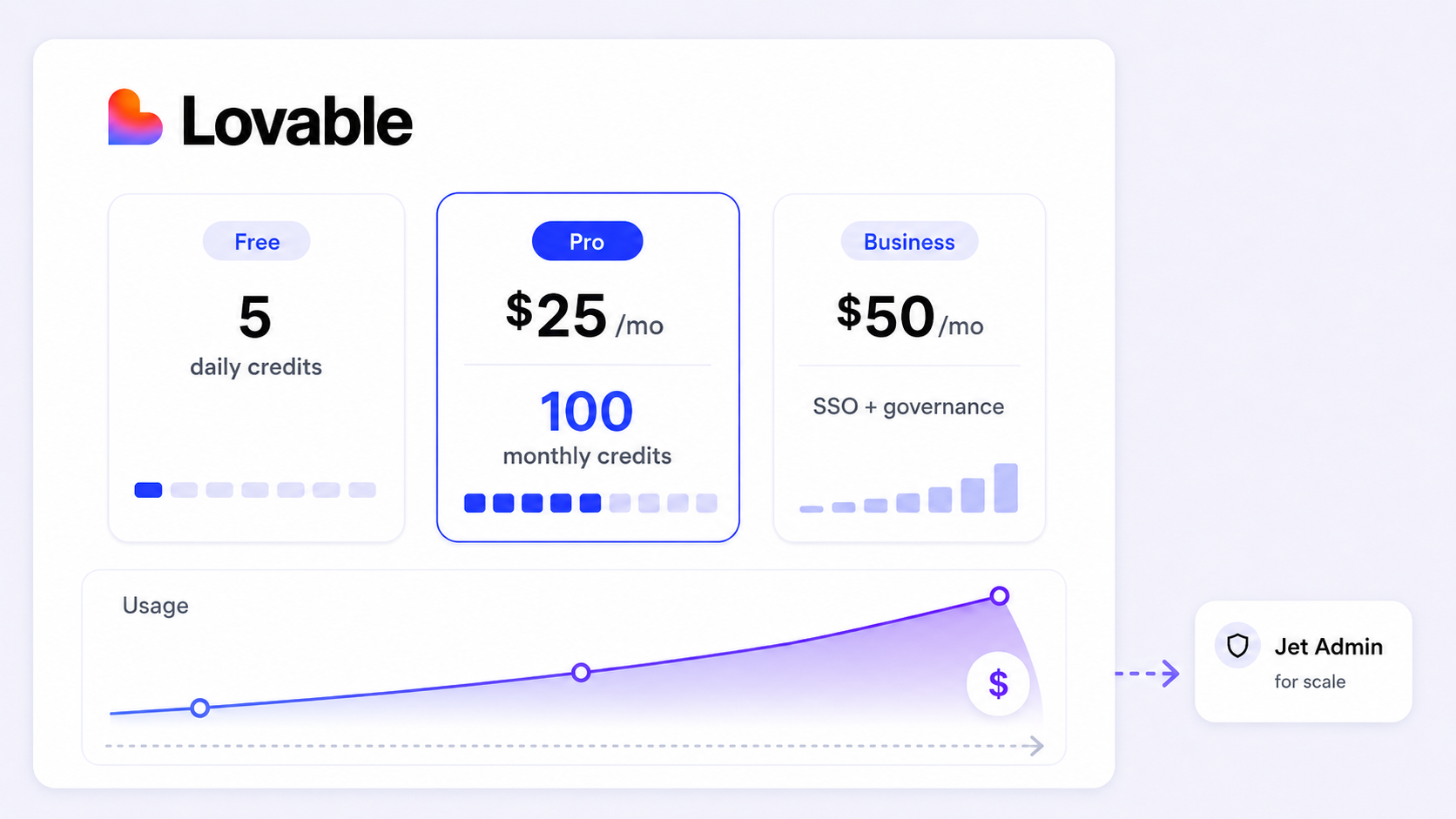
As of July 2026, Lovable offers four pricing plans: Free (5 daily credits, capped at 30 per month), Pro at $25/month with 100 monthly credits, Business at $50/month with SSO and governance features, and Enterprise with custom pricing for large organizations. All plans share a unified credit pool that covers building, lovable cloud hosting, and ai features through a single AI gateway.
Lovable pricing is genuinely attractive when you understand how credits work across build, cloud and ai usage. But credits expire on different schedules, daily grants vanish overnight, and top ups cost more per credit than plan-included credits. Miss these details and your lovable cost can climb fast.
This article focuses on practical total cost of ownership: credit usage patterns, free tier limits, cloud usage overages, and a pricing comparison between Lovable and other ai app builders including Jet Admin. All lovable pricing facts reflect information verified as of July 2026 and may change; always check Lovable's official pricing page before committing.
Jet Admin offers a different model entirely. Rather than per-prompt credits, Jet Admin prices around environments, seats, and usage tiers, making it a more predictable option for teams building production grade internal tools on existing data.
Lovable pricing at a glance (July 2026)
Lovable uses credits as its internal currency. Every action, from generating an initial app structure to running ai features in a deployed app, draws from the same credit balance. Prices are listed in USD, with both monthly and annual billing options available across all paid tiers.
Lovable offers four main lovable plans: Free, Pro, Business, and Enterprise. The free plan is designed for testing and quick experiments. The pro plan starts at $25/month and is the entry point for serious building. The business plan starts at $50/month and adds compliance and workspace controls. The enterprise plan uses custom pricing negotiated for volume and governance.
Free plan users typically receive 5 daily build credits, which accumulate to roughly 30 per month. Paid plans layer a monthly plan credit pool on top of daily grants. On the pro and business plans, unused monthly credits roll over for one additional billing cycle on monthly billing, and can accumulate longer under annual billing.
There is no separate surcharge for different modes of app generation. The same credits power prompt-based building, hosting via lovable cloud, and AI calls from deployed apps through the AI gateway. This means lovable pricing is really about a fixed subscription plus variable credit usage plus optional credit top ups, a structure that feels simple at sign-up but grows complex at scale.
Lovable pricing tiers and who each one suits
Buyers typically choose a tier based on project maturity, team size, and compliance requirements rather than credit volume alone.
Free plan: $0/month. You get 5 daily build credits up to about 30 per calendar month, public projects only, no private projects, no paid top ups, and limited monthly cloud and AI grants. Best suited for personal projects, weekend experiments, or classroom demos.
Pro plan: $25/month with 100 monthly credits plus 5 daily bonus build credits. Lovable allows unlimited collaborators on its Pro plan, and pro plan features include private projects, custom domains, the ability to remove lovable branding, and basic production readiness for small apps. This is where most solo founders and small teams start.
Business plan: $50/month for the same base credit volume but with single sign on (SSO), data training opt out, team workspace permissions, and stricter privacy controls. Business tiers are designed for startups and departments that need governance without a full enterprise contract.
Enterprise plan: Custom annual contracts with volume-based credit pricing, unlimited users, audit logs, SCIM, dedicated support, and negotiated SLAs. This tier targets large organizations standardizing on Lovable across multiple teams.
Which tier fits your scenario:
- Hobby builders and students: Free plan or discounted access (discounts are available for students with a university email address)
- Solo founders validating an MVP: Pro plan
- Product teams iterating weekly: Business plan or higher Pro tiers
- Org-wide rollouts with compliance requirements: Enterprise plan
Tier comparison table: Free, Pro, Business, Enterprise
This table compares four key dimensions across lovable plans: plan price and billing, included credit usage, important limits, and ideal user profile.
Dimension | Free | Pro | Business | Enterprise |
|---|---|---|---|---|
Monthly price | $0 | $25+ | $50+ | Custom pricing |
Billing options | N/A | Monthly or annual billing | Monthly or annual billing | Annual contracts |
Monthly credits | ~30 (via daily grants) | 100 monthly credits + daily grants | 100+ credits + daily grants | Negotiated volume |
Credit top ups | Not available | Yes (50–1,000 increments) | Yes (50–1,000 increments) | Custom arrangements |
Credit rollovers | None; daily credits expire nightly | Monthly credits roll over 1 cycle | Monthly credits roll over 1 cycle | Custom terms |
Key features | Public projects, limited cloud and AI grants | Private projects, custom domains, code editor access | SSO, data training opt out, team roles | Audit logs, SCIM, dedicated support |
Unlimited team members | Yes (but shared small pool) | Yes, unlimited collaborators | Yes, unlimited team members | Yes, unlimited users |
Ideal for | Testing, demos | Solo founders, small teams | Governed startups, departments | Large organizations |
For Pro, credit ladders scale up (e.g., 200, 400, 800 credits) at increasing monthly costs. Business mirrors those tiers at roughly double the plan price but adds compliance controls. On the Enterprise side, per-organization custom pricing is standard.
Actual terms can change, so treat this table as a directional guide. Confirm details on Lovable's live pricing page before committing to any annual plan.
How Lovable credits work (build, Cloud, and AI gateway)
Lovable uses credits to measure and pay for usage across three domains: building apps, hosting them on lovable cloud, and serving AI calls from deployed apps via the AI gateway.
A single credit balance is shared across all workspace activities. However, Lovable also grants usage-specific credit pools: daily build credits, monthly cloud grants, and monthly AI grants. These targeted grants are consumed before general credits.
Build usage: Credits are spent in Plan and Build modes whenever Lovable generates, edits, or updates code. Each message in chat mode costs 1 credit regardless of complexity, while default mode is usage-based. Lovable's credits are consumed based on task complexity: a simple tweak like "make the button gray" costs about 0.50 credits, while "add authentication with sign up and login" runs around 1.20 credits.
Cloud usage: Resources like database queries, network routing, storage, compute, and realtime connections all consume credits. A monthly cloud grant covers initial usage; once exhausted, general credits kick in.
AI gateway usage: When live app users trigger ai features (chat assistants, text generation, image generation), credits are consumed based on tokens and model choice. Heavier models burn more credits depending on complexity and volume.
This unified credit approach is what makes lovable pricing feel simple at sign-up but can hide the exact cost of different underlying drivers once an app is actively used in production.
Where credits come from: grants, plans, and top ups
Lovable workspaces receive credits from multiple sources. Understanding those sources helps avoid surprise credit depletion mid-build or mid-demo.
Usage-specific grants include daily build grants (all tiers), monthly cloud grants, and monthly AI grants. These apply only to their specific usage type and always get used before general credits. Unused usage-specific grants do not roll over; daily build credits reset at midnight UTC and do not roll over, while monthly grants expire at month-end.
General credits come from the monthly plan subscription (Pro or Business) plus any extra credits from one-time credit top ups or annual commitments. These are shared across build, cloud usage, and AI gateway once grants run out.
Credit rollover rules: Monthly credits on active subscriptions generally roll over for one additional month on monthly billing. Under annual billing, unused monthly credits can accumulate until the annual term ends. Daily credits and usage-specific grants never roll over.
Here is a simplified example: a Pro workspace in March 2026 has 100 monthly credits, 5 daily build grants, and a 200-credit top up purchased in January. Each day, the 5 daily build credits get consumed first. Once those are gone, monthly plan credits are used. The January top up (valid for 12 months) sits as a reserve, drawn only after monthly credits are depleted. Unused daily credits vanish at midnight UTC, while any remaining March monthly credits carry into April, then expire if still unused.
Tracking, visualizing, and understanding credit usage
Lovable provides in-app tools to view credit usage, but the signal is mostly retrospective: you see what you spent, not what you will spend.
The credit bar appears on the Lovable dashboard and project editor, showing remaining daily build, monthly, and top-up credits at a glance. For detailed data, navigate to Settings → Plans & credit usage. This view surfaces remaining amounts by credit type.
The Credit balance dialog (available to admins on paid plans) lists each credit type with its expiry date and remaining amount. Lovable consumes credits closest to expiry first, helping minimize loss from expired pools. A low credits alert can notify workspace owners when balances drop below a threshold.
The Breakdown tab (Pro and Business, not Enterprise) shows how general grants split by type and expiry, helping predict which pool runs out first. The History tab tracks up to 12 months of additions, removals, and expirations with event type, date, and credit delta.
Usage details under Settings include charts and filters by time range, project, member, and type. These views can reveal which projects or teammates are driving cloud and ai costs, making it easier to save credits by optimizing high-burn workflows or consolidating projects.
Free tier, credit usage caps, and when "free" stops feeling free
Lovable's free plan is genuinely useful for a first look: no card required, fast sign-up, and enough credits to build a simple landing page or test an idea. Lovable offers a free plan for testing purposes, and that is precisely what it is best at.
The free plan provides 5 daily credits, capped at 30 monthly. Daily credits are granted for roughly the first 6 days of each month (6 × 5 = 30), then stop until the 1st of the next month at 00:00 UTC. Free plan users also receive small monthly cloud and AI grants, but these are minimal.
When credits run out, building pauses. Lovable cloud hosting for apps and ai features may degrade or pause entirely. Users get in-app notifications prompting them to wait for the next grant or upgrade. There are no paid top ups available on the free tier.
Lovable's free plan works for weekend experiments, single-page prototypes, or brief classroom demos. But ongoing product work or personal projects that demand consistent iteration will quickly need at least the pro plan. Because each prompt consumes a visible percentage of a small daily pool, free plan users often under-experiment or switch to external tools during serious builds to conserve credits. The free tier is a taste, not a workflow.
Paid plans, business tiers, and credit top ups
Once teams outgrow the free tier, they typically choose between upgrading to a paid plan and buying occasional credit top ups for one-off spikes.
Pro and business plans scale credit volumes starting at 100 monthly credits. Higher-tier options (200, 400, 800+ credits) are available at increasing monthly costs. Lovable plans support unlimited members in a workspace, so credit volume rather than seat count determines capacity. Bolt's Pro plan costs $25/month but charges per user, making Lovable's unlimited collaborators model a distinct advantage for teams.
Credit top ups on paid plans are one-time purchases via Stripe, available in increments from 50 to 1,000 credits. Top up credits are valid for 12 months from the last purchase and apply to the same unified credit pool. Pro users pay roughly $15 per 50 additional credits, while Business users pay about $30 per 50.
Auto top-up lets workspace owners set rules that automatically buy more credits when balance falls under a threshold. You can configure per-trigger amounts and monthly maximum spend. This prevents interruptions during demos or production-like deployments.
Manual one-time top ups are useful for mid-cycle spikes (big feature builds, demo day traffic) without changing your subscription tier. Multiple top ups can stack.
The tradeoff: repeated top ups cost more per credit than plan-included credits. If you regularly demand credit top ups, upgrading to a higher Pro or Business tier with better per-credit pricing will likely lower your overall lovable cost.
Annual billing, credit expiry, and long-term cost planning
Lovable encourages annual billing by offering discounted effective monthly rates and more generous rollover rules for unused credits.
On monthly billing, credits are issued each billing cycle. Unused monthly credits roll over for one additional month. If your subscription stays active, March credits remain available through April, then expire if still unused at the end of April's billing period. Daily and usage-specific grants still do not roll over.
On annual billing, you pay for the full year at checkout. Monthly plan credits are still issued each month, but unused monthly credits can accumulate until the annual term ends, at which point remaining credits typically expire. This makes an annual plan attractive for teams with seasonal build patterns.
Lovable's credit expiry order consumes credits closest to expiry first. This minimizes waste but makes it harder to trace which top up or subscription month funded a specific build.
Business-planning implications: Teams planning bursty build phases (e.g., a Q3 feature sprint) may benefit from annual billing plus pre-purchased credit reserves. Teams with uncertain usage might prefer monthly billing and conservative top ups to avoid paying for unused credits.
On cancellation, you typically revert to Free at end of billing period. Remaining paid credits may expire, so plan your spend-down before terminating pro, business, or enterprise contracts to avoid losing credit rollovers.
Total cost of ownership: beyond "How much per month?"
The plan price is only the starting point. Real lovable cost is shaped by credit usage, cloud and ai consumption, team behavior, and governance needs. Hourly or monthly costs of subscriptions might include hosting and AI feature usage separately, so tracking total spend requires attention.
Main TCO drivers include:
- Overall credit burn (build + Cloud + AI)
- Number of active projects and their complexity
- Traffic volume to deployed apps
- AI model choice intensity (heavier models = higher ai costs)
- Development style (prompt-heavy vs writing code in the code editor)
- Frequency of rebuilds and "regenerate" loops
Credit unpredictability is the core TCO risk. Complex prompts, debugging loops, and repeated regenerations can multiply spend compared to carefully batched prompts. If your team tends to hit persistent errors and retry frequently, the number of credits consumed can escalate quickly.
Governance features increase plan price but may lower risk-adjusted cost. Business and enterprise tiers add SSO, data privacy controls, audit logs, and centralized workspace management, all of which reduce risk for regulated teams.
Worked examples:
- Solo founder on Pro 100: Building a single MVP with ~20 prompts/week, monthly spend stays near $25. Occasional top ups during launch week add $15–30.
- 3-person team on Business 200: Iterating weekly on a SaaS. Shared credit pool depletes faster; expect $50/month base + $30–60 in top ups during heavy sprints.
- Enterprise team: 50+ users prototyping across departments. Negotiated credit pool of 5,000+/month with dedicated support and custom pricing keeps per-credit cost low.
Unlike some competitors, Lovable does not charge per-seat on pro and business. But the shared credit pool means teams must coordinate usage. Without governance, one heavy user can exhaust credits for everyone.

When "lovable pricing" fits-and when another model is better
Lovable's credit-based dev pricing is genuinely attractive for certain use cases, especially short-lived prototypes, landing page tests, and educational projects where rapid AI building delivers outsized value per credit.
Lovable pricing works well when:
- Solo or small teams build 1–2 React/Supabase apps per quarter
- Hackathons or classroom labs leverage the free tier for quick demos
- Early-stage founders run A/B tests on MVP features and can save credits by planning prompts carefully
- You want to host apps and test ai features without managing infrastructure
Credit-based pricing can become painful when:
- Complex, long-running SaaS projects need frequent AI-generated updates and the number of credits consumed is hard to predict
- Teams need predictable monthly budgets for finance or legal review
- Usage spikes with new internal adoption, driving cloud usage and ai costs above plan assumptions
- You need mobile apps, custom integrations, or code quality guarantees that require extensive iteration
By comparison, some ai app builders and platforms use flat-rate or seat-based models: IDE-based assistants charge flat subscriptions, while internal-tool builders price by environments, data volume, or named users. Superblocks, for instance, is better for production-grade internal tools than Lovable when long-term stability matters more than rapid prototyping speed.
If you value granular pay-for-what-you-use and are comfortable monitoring credit dashboards, Lovable is attractive. If you prioritize bill predictability, a different pricing model may be easier to manage. Teams that need to skip lovable entirely for governance reasons should look at platforms with clearer cost structures.
Where Jet Admin fits in this picture
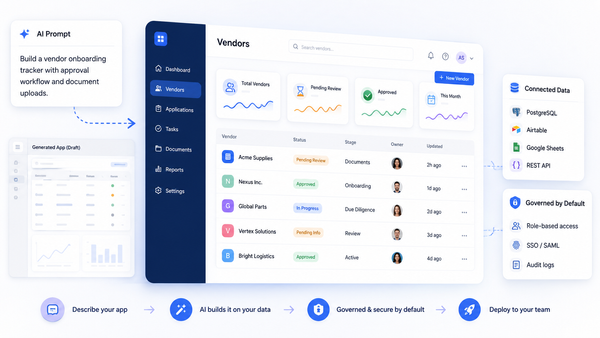
Jet Admin is a platform for building secure business apps on top of existing data sources: databases, APIs, spreadsheets, and SaaS tools. AI is one of several building modes, not the sole pricing lever. Jet Admin can generate app interfaces and backend logic, then let teams refine through prompts, workflows, or imported React code.
Unlike Lovable, Jet Admin's pricing is not driven by per-prompt credits. Buyers evaluate plans based on workspaces, environments (staging and production), security and governance features, and support level. This means Jet Admin buyers treat AI as an accelerator within a predictable plan, while Lovable buyers must continuously monitor credit usage to keep monthly costs within budget.
Consider Jet Admin over Lovable when:
- Your organization prioritizes auditability, role-based access, and secure connectivity to production data
- You're building internal tools that must live for years, not weeks
- You prefer straightforward business tiers with a teams plan structure over credit-led pricing plans
- You need chat history, workflow automation, and custom integrations without tying every interaction to a credit counter
For teams evaluating governed internal tools with predictable pricing, reviewing Jet Admin's pricing page gives a clear picture of how environments, seats, and feature tiers map to monthly cost.
Decision guide: choosing the right tool and pricing model
This section synthesizes the article into a practical decision tree.
Choose Lovable if:
- You need fast AI-generated React apps with a low entry cost
- You're comfortable managing credits, cloud usage, and the credit bar
- Your team is small with unlimited collaborators who can coordinate usage
- You favor a free tier for experimentation before committing
Lovable might not be the best fit if:
- Your project has unpredictable or heavy AI workloads and you can't forecast how many credits you'll need
- You must provide budget certainty to finance or legal teams
- You dislike metered, per-credit systems where credits expire on different schedules
- You need production grade internal tools that persist beyond prototype phase
Consider Jet Admin if:
- You're building secure internal business apps on live production data
- You need RBAC, audit logs, and environment separation
- You want AI assistance without tying every interaction to a credit counter
- You prefer clearer business tiers over granular credit micromanagement
Practical evaluation approach: Spend 1–2 weeks testing with Lovable's free or Pro plan while piloting Jet Admin on a key internal workflow. Compare real-world effort, the exact cost in credits versus flat subscription, and code quality across both before standardizing.
If your use case leans toward governed internal tools or long-lived business apps, explore Jet Admin's product capabilities and try a template to see how the building experience compares.
FAQ: Lovable pricing, credits, and Jet Admin
These questions address common edge cases not fully covered above, especially around free tier details, credit expiry, and picking between tools. All answers reflect information available as of July 2026. Confirm current terms on each vendor's official pricing page before buying.
How does Lovable's free plan really work in practice?
Lovable's free plan gives 5 daily build credits with a monthly cap around 30 credits, typically granted over the first 6 days of each month. Daily credits reset at 00:00 UTC. You can build public apps and collaborate with others, but you cannot rely on the free tier for sustained development because credits deplete quickly during active sessions. Once credits are exhausted, you must wait until the next grant cycle or upgrade. There are no paid top ups on the Free plan. Students with an eligible university email address may qualify for discounted access to paid tiers.
Do Lovable credits expire if I don't use them?
Yes. Multiple credit types expire on different schedules: daily build credits expire each day if unused, unused monthly credits on monthly billing roll over for only one additional billing cycle, and top up credits are generally valid for 12 months from last purchase. On annual billing, unused monthly credits typically remain usable until the annual term ends, then expire. Lovable uses the earliest-expiring credits first, which reduces loss but makes it harder to map each prompt or cloud charge back to a specific purchase.
What happens if my Lovable workspace runs out of credits mid-project?
Once all relevant credit pools reach zero (daily, monthly, grants, and top ups), Lovable pauses usage that requires credits: further AI builds, lovable cloud hosting capacity, and AI gateway calls from deployed apps. Users see in-app alerts, chat nudges, banners, or emails prompting them to wait for the next grant, purchase a top up on pro and business plans, or upgrade their subscription tier. This can affect demos or production-like environments, so teams should monitor credit usage through the low credits alert and consider auto top-up where uninterrupted service is critical.
Is Lovable's credit-based pricing cheaper than flat-fee tools?
It depends on workload. For simple prototypes and modest usage, Lovable can be cheaper because you only pay for credits you consume, especially at $25/month Pro levels. For heavy or unpredictable usage involving large projects, frequent rebuilds, or intense AI gateway calls, credit burn can make Lovable more expensive than flat-fee AI editors or traditional SaaS tools. Track one week of real work in Lovable and compare your effective monthly cost to a flat-rate alternative using the same tasks before committing to a monthly plan or annual plan.
When should I choose Jet Admin instead of Lovable?
Jet Admin is a better fit when you're building secure internal business apps on live production data, require strong governance (RBAC, auditability, separation of environments), and want predictable pricing rather than metered credits. Jet Admin still uses AI to accelerate building, but the primary cost drivers are environments, data connections, and organizational scope, not per-prompt credit usage. Buyers who care most about compliance, long-term maintainability, and transparent pricing should treat Lovable as a rapid prototyping option and Jet Admin as the platform for long-lived internal tools with a clear chat history of decisions and changes.