If you're evaluating no-code platforms for your next web or mobile project, understanding bubble pricing is the first step toward avoiding cost surprises. This guide breaks down every plan, explains the workload system that drives your real monthly spend, and helps you decide whether Bubble is the right fit or whether alternatives deserve a closer look.
Pricing summary
- Bubble pricing starts at $0/month for the free plan and scales through paid plans (Starter, Growth, Team) up to custom enterprise pricing. The Starter plan costs $59/month and includes 175,000 WUs for the Web+Mobile track, while the Team plan is priced at $349/month with 500,000 WUs. Bubble's pricing tiers have significant jumps in cost between levels.
- Your real bubble cost depends less on the headline subscription and more on how much workload your app consumes. Workload units measure server processing power usage, and each pricing tier includes a set number of monthly workload units that reset every billing cycle.
- The free tier is powerful for learning and prototyping but cannot host a live version on a custom domain. Most teams upgrade to Starter or Growth before onboarding real users.
- Enterprise pricing is custom and based on specific needs, making it appropriate when compliance, governance, and formal procurement outweigh list-price concerns.
- Teams comparing bubble.io pricing with alternatives like Jet Admin should evaluate total cost of ownership, including data sources, governance, support, and long-term scalability.
How Bubble pricing works (September 2026)
All pricing details in this article were checked in September 2026. Always confirm on Bubble.io before purchasing because plans and limits can change.
Bubble.io pricing ranges from a free plan (50k WUs, 1 editor, no live deployment) through Starter, Growth, and Team tiers, plus Enterprise with custom pricing. Plans are organized by product track: web apps only, native mobile apps only, or Web+Mobile. Choosing the Web+Mobile track costs more but lets you share the same backend database and logic across platforms.
Bubble cost is determined by your chosen track, plan tier, included workload units, number of app editors, and optional add-ons like an extra workload tier. WUs act as a usage meter covering database queries, workflows, and api connections, making them the main driver of total cost for any bubble app with real traffic. Plans bill monthly or annually, with annual billing offering meaningful discounts. The free plan runs on Bubble's domain with important feature limits.
A Note on "Bubble Pricing" as an Economic Term
If you arrived here searching for the economic concept, it is worth a quick clarification. In economics, the term "bubble pricing" describes inflated prices driven by speculation rather than value. Bubble pricing is when asset prices exceed intrinsic value due to speculation, and bubbles generally progress through five stages: displacement, boom, euphoria, profit-taking, and panic. Speculation often drives the boom phase of an economic bubble, and the wealth effect leads consumers to spend more during a bubble, while consumers may take on excessive debt to invest in assets during a bubble. Market volatility increases as prices dramatically fluctuate during bubble conditions, and misallocation of capital occurs when investment flows to overpriced assets instead of productive areas. A burst bubble can result in widespread job losses and economic slowdowns, and bubble pricing can lead to financial instability if it bursts suddenly.
By contrast, this article focuses on Bubble.io, the no-code development platform. Concepts like dynamic pricing, which involves adjusting prices based on demand and market conditions, and value-based pricing, which focuses on delivering measurable outcomes to customers, are relevant to how any SaaS vendor structures plans. Regularly monitoring price elasticity can inform sustainable pricing strategies, and businesses should segment customers to optimize pricing strategies. Building customer loyalty can reduce reliance on volatile pricing, whether you are setting your own product's prices or evaluating a vendor's plan structure.

Bubble pricing at a glance
Bubble pricing is now organized into three distinct tracks. The web track targets browser-based web apps. The mobile track targets native ios and android apps published to app stores. The Web+Mobile track bundles both, letting you build and deploy across platforms from a single project.
Each bubble app has its own app plan, meaning you pay per app, not per account. This matters for agencies and companies managing many apps across clients or departments. All tracks share similar concepts like workload units, editor seats, server logs retention, and versioning, but Mobile and Web+Mobile tracks cost more because they include mobile build submissions and distribution to the Apple App Store and Google Play Store.
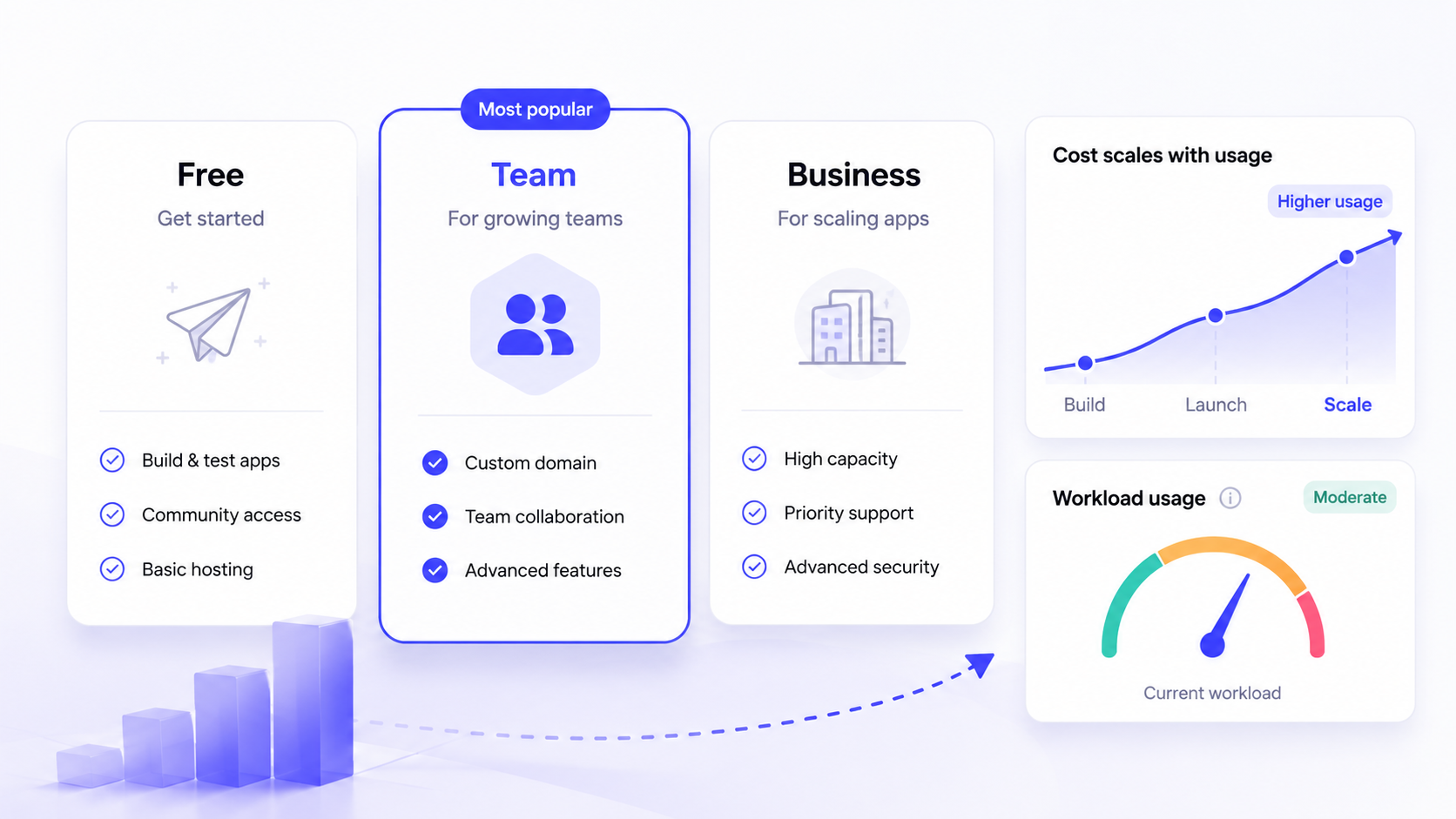
Rough monthly ranges (annual billing) run from $0 on the free tier through roughly $29–$59 on Starter, $119–$209 on Growth, $349–$549 on Team, depending on track. Enterprise sits above all of them with custom pricing.
Plan comparison
The table below summarizes the key difference between tiers. Prices shown are approximate for the Web track with annual billing; Web+Mobile pricing is higher.
Plan | Approx. Monthly Price | Included WUs | Editors | Log Retention | Custom Domain | Best For |
|---|---|---|---|---|---|---|
Free | $0 | 50,000 | 1 | 6 hours | No | Learning, prototyping |
Starter | ~$29–$59 | 175,000 | 1 | ~2 days | Yes | Small MVPs, early SaaS |
Growth | ~$119–$209 | 250,000 | 2 | ~14 days | Yes | Production SaaS, customer-facing apps |
Team | ~$349–$549 | 500,000 | 5 | ~20 days | Yes | Agencies, multi-editor teams |
Enterprise | Custom | Custom | Custom | Custom | Yes | Regulated, high-scale orgs |
Prices vary by track. Verify the latest figures on Bubble's pricing page.
When moving from Web to Web+Mobile, WU allocation is shared across both surfaces, but subscription cost increases to cover mobile builds and publishing. Extra workload tiers or overage charges can significantly change the effective price compared to the headline plan fee. Exceeding WU limits costs $0.30 per 1,000 WUs, and workload usage is cumulative across web and mobile apps on the same project.

What each Bubble plan includes
Each major bubble plan serves a different stage of product development. Here is who each tier suits and where the main limits fall.
Free plan. Bubble's pricing starts at $0/month for the Free plan. You get 50k WUs, 1 app editor, no live deployment on a custom domain, Bubble branding on the app URL, and only 6 hours of server logs retention. Bubble free is ideal for learning, tutorials, and testing an idea before committing budget. Note that Bubble requires about five months to master its interface, so the free plan gives you plenty of time to learn without spending.
Starter plan. The starter plan is the entry-level paid tier. It unlocks a custom domain, a live version of your app, recurring workflows, plugin subscriptions, and roughly 175k monthly workload units. Still limited to a single editor, it suits small MVPs, early-stage SaaS products, and internal tools with a modest user base.
Growth plan. Growth brings 2 editors, around 250k WUs, 14-day log retention, version control branches, and two-factor authentication. This is the default for serious customer-facing apps with dozens to hundreds of active users, offering stronger team collaboration and advanced features for development and testing.
Team plan. At roughly $349–$549/month depending on track, the team plan provides 5 editors, ~500k WUs, sub-apps, 25 version-control branches, and deeper collaboration features. Suited for agencies, larger product teams, or apps with multiple contributors and higher scale requirements.
Enterprise plan. Enterprise pricing is entirely custom. It includes dedicated infrastructure, choice of hosting region, static IPs, SOC 2 Type II compliance, SLAs, and priority support. Contact sales with workload estimates and compliance requirements.
List prices alone do not tell the full story. Additional wus, plugins, and third-party services all influence your real monthly spend.
Free plans and discounts
Many teams start on the free plan and want to stay as long as possible. Benefits include cost-free experimentation, access to Bubble's visual editor and core features, 50k WUs for testing, and suitability for hackathons and internal prototypes.
Key limits: no custom domain, no production deployment, single editor, minimal logs, and restricted access to advanced features like version control branches. It is a sandbox, not a hosting solution.
Bubble supports educational institutions and students with documented discounts on some paid plans, and non-profit organizations can request special pricing. Confirm exact terms on Bubble's current education pages.
A simple rule: if you need to onboard real users, connect a custom domain, or meet minimal security requirements, plan to upgrade to at least the right bubble plan (Starter or Growth) before launch. Use the free tier to de-risk your idea, but budget early for a paid plan if you expect real adoption. Bubble's flexibility on the free tier makes it a solid prototyping environment, though the steep learning curve means you should allow time for development before committing to paid.
Enterprise plans and custom quotes
Bubble Enterprise is designed for large organizations with high-risk use cases. Its pricing is negotiated through sales, not self-serve checkout.
Typical triggers: strict compliance requirements (SOC 2, GDPR, data residency), large user bases with spiky workloads, formal procurement processes, and the need for guaranteed SLAs. Enterprise-level benefits include dedicated infrastructure with choice of hosting region, static IPs, direct read-only database access, advanced logging, and governance features like SSO.
Enterprise pricing often combines a platform base fee plus usage. Teams should prepare workload estimates - expected users, workflows, data volumes - before entering discussions. Agencies sometimes mix standard plans for smaller clients with Enterprise agreements for their largest accounts, which adds flexibility but complicates billing.
For many mid-market products, the team plan is sufficient. Enterprise makes sense when procurement, risk, and compliance drive the decision more than raw feature needs.
How Bubble workload units affect your bill
Workload units are Bubble's metric for CPU, database, and workflow usage. Every action your app performs consumes WUs: simple page loads consume 0.5 to 2 WUs, while complex searches can consume 10 to 50 WUs. Bulk data imports, recurring workflows, and heavy API calls sit on the higher end.
How much workload your app actually uses depends on traffic volume, query complexity, and workflow design. Each plan includes a monthly WU allowance that resets every billing cycle. When you exceed it, Bubble charges $0.30 per 1,000 WUs as overages, or you can pre-purchase a workload tier add-on at a lower per-unit rate. You can also disable overages entirely, but risk app downtime if your allocation runs out.
Teams can control WU costs by:
- Optimizing database queries and reducing unnecessary searches
- Minimizing redundant workflows and conditional actions
- Moving heavy batch jobs to off-peak hours
- Offloading processing to external services where practical
Confirmed facts: WUs as a billing metric and the $0.30 overage rate come from Bubble's public documentation. Guidance like "upgrade if you consistently hit 80% of your WU cap" is interpretive, not an official threshold.
To understand how bubble pricing work in practice, monitor WUs weekly in the App Metrics dashboard rather than relying on plan names alone.
Costs beyond the Bubble subscription
Beyond WUs, several other factors can push bubble cost above the base subscription.
Editor seats. Free and Starter limit you to 1 editor. Growth offers 2, and the team plan includes 5. Needing more app editors can force a plan upgrade even if WU usage stays low.
Environments and version control. Lower tiers restrict the number of branches and live versions. Teams that need proper development, staging, and production environments with frequent testing typically require Growth or Team.
Storage and logs. File storage ranges from ~0.5 GB (Free) to ~1 TB (Team/Enterprise). Media-heavy projects may need external storage, adding cost. Server logs retention spans from 6 hours to 20+ days depending on your current plan.
Plugins and marketplace add-ons. Many powerful Bubble plugins carry paid subscriptions that add dozens or hundreds of dollars monthly on top of io pricing. Premium design systems and integration plugins are especially common costs.
Third-party services. Stripe, Twilio, email providers, analytics tools - Bubble does not include their usage fees. Budget separately for every external API your app relies on.
The right formula: headline plan price + realistic WU usage + plugins + third-party APIs = true monthly cost.
Jet Admin vs Bubble: total cost and fit
Pricing comparisons should consider total cost of ownership, not just monthly subscription numbers. Bubble's WU-based model, per-app billing, and plugin costs can influence long-term TCO, especially for organizations needing multiple apps or environments.
Jet Admin is a no-code platform for building secure business apps and customer portals on top of existing data sources. It connects to databases like PostgreSQL, MySQL, BigQuery, and Snowflake, plus SaaS tools like Stripe, Salesforce, HubSpot, and Slack, as listed on its integrations page. Building on existing data can reduce duplication and infrastructure costs compared with rebuilding everything into a Bubble database.
Jet Admin includes governance capabilities such as fine-grained permissions on rows and columns, role-based access, SSO/SAML, audit logs, and branded portal sharing. For teams that mainly need secure internal tools or customer-facing portals on existing systems, evaluating Jet Admin's approach alongside bubble.io pricing is worthwhile, particularly if avoiding per-app rebuilds and usage based pricing model overhead is a priority.
Adalo is another alternative worth noting: Adalo starts at $36/month for unlimited usage and Adalo publishes true native apps directly to app stores, which contrasts with Bubble's web-first approach. Adalo's visual builder is easier than Bubble's complex interface, making it appealing for simpler native mobile projects destined for Google Play or the Apple App Store.

Which Bubble plan should you choose?
Use these decision branches as a starting point:
- Validating an idea with under ~50 test users? Start on Free. Plan to upgrade before launch.
- Building a revenue-generating SaaS with dashboards for hundreds of customers? Start on Growth and monitor WUs closely.
- Need 3–5 editors or multiple sub-apps? Consider the team plan from the outset.
- Agency managing client projects? Use separate Starter or Growth plans per client app, or explore Bubble group and agency options.
- IT/operations team at an established company? Factor in security reviews, data residency, and integration with internal systems before choosing between Bubble, Jet Admin, or a mix of tools. If you need native apps for both Google Play and the Apple App Store, evaluate whether Bubble or a native mobile-focused tool better fits.
Pre-commitment checklist:
- How many monthly active users do you expect in year one?
- Which data sources need to be integrated?
- Do you require SSO or fine-grained access control?
- How many editors will work on the app?
- What is your acceptable monthly cost limit, including overages and plugins?
Frequently asked questions
Is Bubble Really Free to Use Long-Term, and What Are the Hidden Limits?
The free plan can be used indefinitely for learning and small internal prototypes. However, it lacks custom domain deployment, production-grade features, and collaboration beyond a single editor. You are capped at 50k WUs and 6 hours of log retention. Treat it as a sandbox for testing rather than a final hosting solution for customers.
How Does Bubble Handle Overages If I Go Above My Included Workload Units?
When an app exceeds its monthly WU allocation, Bubble bills additional wus at $0.30 per 1,000 WUs, unless you have pre-purchased a workload tier add-on at a discounted rate. You can disable overages in your app plan settings, but doing so risks downtime if you run out. Check your current plan's settings and monitor usage proactively.
Can I Switch Between Bubble Plans or Billing Cycles Without Downtime?
Bubble generally allows upgrading or downgrading plans and switching between monthly and annual billing via the dashboard, with pro-rated charges applied. Plan changes should not cause app downtime, but some features may be added or removed based on the new pricing tier, so test accordingly.
Does Bubble Pricing Include Publishing to the Apple App Store or Google Play?
Bubble's Mobile and Web+Mobile tracks include mobile build submissions, but you still need Apple Developer and Google Play developer accounts (with their own fees). Standard web-only bubble plans do not cover native publication. Some teams use third-party wrapping tools for native apps, which adds separate cost.
What Discounts Does Bubble Offer for Students, Non-Profits, and Educational Institutions?
Bubble publicly mentions discounts for students, educators, and qualifying non-profit organizations. Exact percentages and eligible plans can change, so check Bubble's current education and non-profit pricing pages for up-to-date terms.
All details in this article reflect Bubble's public pricing as of September 2026. Plans, features, and rates can change - always verify on Bubble.io before purchasing.
Plan your next step
Understand the mechanics - workload units, editor seats, per-app billing - and pick a plan aligned with realistic usage. Treat the free tier and starter plan as stepping stones, not long-term homes for production code apps.
Track WU usage, plugin costs, and external API fees from the first prototype. Build a simple spreadsheet to forecast bubble cost over 12–24 months as usage and growth increase. Watch for unexpected charges from overage spikes during peak periods.
If your main need is secure, data-connected internal apps or customer portals on existing databases and SaaS tools, evaluate Jet Admin's customer portal to compare pricing and governance trade-offs. Map your requirements, review Bubble's official pricing page, and if relevant, sign up for Jet Admin to prototype on live data as a practical comparison.