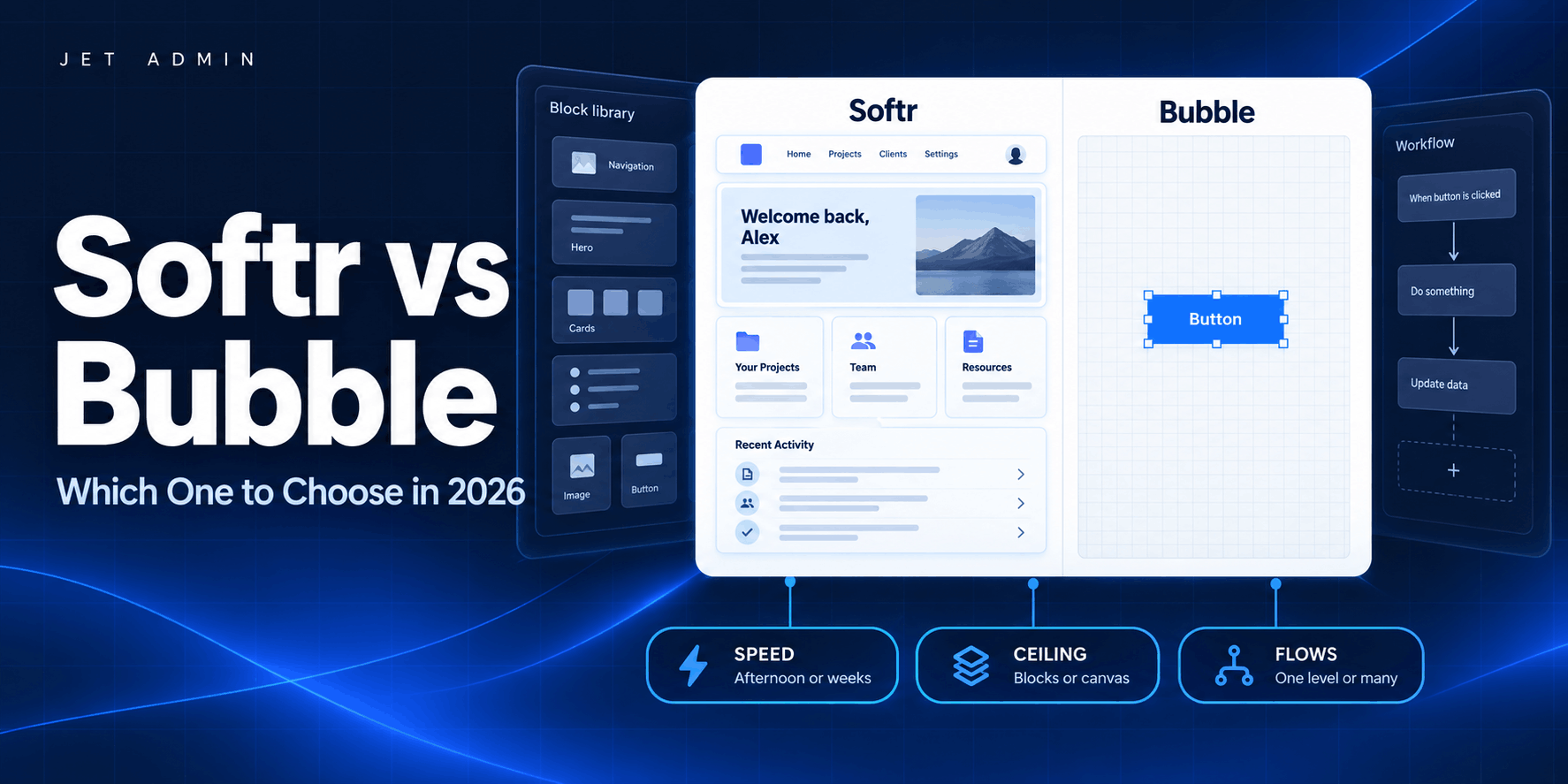
Softr and Bubble sit at opposite ends of the same market. Softr removes the canvas entirely and hands you blocks; Bubble hands you a canvas and expects you to learn it. One ships a portal this afternoon, the other builds a product over weeks.
In a Bubble vs Softr comparison the question is almost never which is more capable. It is whether the thing you are building needs the capability. All prices were checked against each vendor's own pricing page on September 26, 2026, with the billing toggle set to monthly.
Choose Jet Admin if the app is an internal tool or a client portal on your own database and permissions have to hold up to review. Choose Softr if the portal is lists, detail views and forms on Airtable and you want it live today. Choose Bubble if you are building a product with custom UX and you accept a proprietary runtime to get it.
Softr vs Bubble at a glance
Jet Admin | Softr | Bubble | |
|---|---|---|---|
Built for | Internal tools and client portals | Portals and simple internal apps | Full products and SaaS |
Interface model | Canvas with granular control | Pre-built blocks, no canvas | Full visual canvas |
Data | Your databases, warehouses, APIs | Airtable, Google Sheets, databases | Bubble’s own data store |
Complex multi-step flows | Yes | No | Yes |
Permissions | Row and field level, SSO | Higher tiers | App-level, plugin-assisted |
Code export | Supported | No | None at any price |
Time to first app | Hours | An afternoon | Days to weeks |
Entry price | Free, then $20/mo — unlimited users | Free (5 app users, 5K records), then $25/mo | Free (50K WU), then $69/mo ($59 annual) |
What Softr is
Softr builds client portals and simple internal apps from pre-made blocks on top of Airtable, Google Sheets or a database. There is no drag-and-drop canvas: you pick a list block, point it at a table, and publish. That constraint is the product, and it is why non-technical teams ship in an afternoon.
It is also the ceiling. Because you cannot reach individual inputs, actions and variables, a flow like select a customer, open a transaction, check its log and issue a refund is not buildable. Softr is not designed for multiple levels of related data in one sequence.
What Bubble is
Bubble is a complete no-code development environment with its own database, workflow engine and runtime, plus a marketplace of thousands of plugins. Founded in 2012, more than 400 employees, over $150 million raised. It builds the things Softr cannot, and asks for weeks of learning in return.
Pricing works differently in a way that matters
Softr charges by plan. The free tier covers unlimited apps but caps you at 5 app users, 5,000 database records and 500 workflow actions a month; Basic is $25 a month, Pro $119, Business $395 on monthly billing, or $19, $99 and $329 billed annually. The catch that people meet after building: custom code and API connectors are not on the entry plan. Reaching them means Pro, nearly five times Basic. Softr pricing checked September 26, 2026.
Bubble charges for work done. Workload units meter server activity, with a page load costing 0.5 to 2 WUs and a complex search 10 to 50. Free includes 50,000 units a month, Starter 175,000 at $69 ($59 billed annually), Growth 250,000 at $249 ($209), Team 500,000 at $649 ($549). Softr’s bill is predictable and steps at feature boundaries; Bubble’s is unpredictable and tracks traffic. Bubble pricing checked September 26, 2026.
Where each one wins
For a read-mostly client portal on Airtable, Softr wins outright. Nothing else here gets there as fast, and the extra capability of the alternatives is capability you will not use.
For a product with customers, pricing pages and custom interactions, Bubble wins, because Softr cannot do it at any tier.
Between those two sits the case neither serves well: an operational tool with real permissions, approvals and a database that was never going to stay in Airtable.
Who can build and who can maintain
Softr needs no learning to speak of. Someone in operations can assemble a portal between meetings and change it later without asking anyone. That is the whole value proposition and it is not a small one.
Bubble does not require programming but does require learning Bubble: an internal logic language, its own conventions, weeks rather than hours. No code and no learning are different claims. The question worth asking before you start is who edits this in a year, and whether that person will still be here.
Design and how the app looks
Softr apps look like Softr apps. The blocks are well designed and the trade is that your portal resembles every other Softr portal, which matters more for a customer-facing product than for an internal one.
Bubble gives you a canvas and gets much closer to a bespoke interface, without reaching pixel-perfect through standard capabilities. If your portal is the product your customers see, that difference is worth the weeks.
Data, integrations and the ceiling
Softr reads Airtable, Google Sheets and some databases. It does not connect MongoDB, Firebase, Snowflake or GraphQL, so a portal on top of a real backend is out of scope. Airtable itself caps standard plans at 50,000 records per base, which is usually the ceiling teams meet first.
Bubble carries its own database and reaches external services through plugins and API calls. Capable, and the data still lives in Bubble rather than with you.
Permissions and external users
Both handle members and simple roles. Softr places real access control and SSO on higher tiers, so the plan you evaluate on is often not the plan you will need. Bubble uses privacy rules inside the platform, workable but living alongside plugins you did not write.
If the portal has customers whose records must never touch each other, test this properly during evaluation rather than trusting either description.
FAQ
Is Softr cheaper than Bubble?
At the entry level Softr is the cheaper start, $25 against Bubble’s $69 a month ($59 billed annually). They diverge on what triggers the next tier. Softr steps up when you need custom code and API connectors, which lands on the $119 Pro plan, and again when builders, app users, records or workflow actions run out. Bubble climbs when traffic grows, because workload units run out — and its next step, Growth at $249, is a large one.
Can Softr build complex multi-step flows?
No, and this is the clearest limitation on the page. Without a canvas you cannot reach individual inputs, actions and variables, so a sequence with several levels of related data is not buildable at any tier.
Can I export my app from either one?
Neither exports the application. Bubble is explicit that code export does not exist on any plan; Softr is a hosted block builder with the same practical outcome. Data can be exported from both.
Which is better for a client portal?
Softr, if the portal is lists, detail views and forms on Airtable. Bubble, if the portal has unusual interactions or is really a product. Jet Admin, if it has real permissions, approvals and a database you own.
Does Softr work without Airtable?
Yes, it connects Google Sheets and some databases as well. Airtable remains the path with the least friction, and most of the template ecosystem assumes it.
Where Jet Admin fits
Jet Admin covers the portals Softr covers, but runs on the database you already have rather than a copy, and handles the multi-step flows Softr cannot. Row and field level permissions, SSO, approval flows and server-side filtering for multi-tenancy come as product features rather than as higher tiers. Deployment covers cloud, your own infrastructure and on-premise. Pricing is Free, Pro $20 a month ($16 annual) and Business $100 ($80), with unlimited users on every plan.
The honest limitation: it is not for public marketing sites or consumer products, which is where Bubble and, at the simple end, Softr are stronger.
Bubble vs Softr: picking one
Choose Softr if the portal is simple, the data lives in Airtable, and speed beats everything.
Choose Bubble if you are building a product and can absorb the learning curve and the usage-based bill.
Look at Jet Admin if the flow has more than one level, the permissions have to be defensible, or the data belongs in a real database.