
Key Takeaways
- Replit AI is a browser-based AI coding and app-building environment that generates apps from natural language prompts and automates coding, debugging, and deployment in a single platform. It combines a cloud IDE, app hosting, and an AI agent that can scaffold entire projects.
- Replit AI is ideal for students, indie devs, vibe coders, and small teams running hackathons or side projects. It falls short for governed internal tools, strict compliance environments, and complex enterprise apps where audit trails and role-based access matter.
- The platform offers both a replit agent that builds whole apps from prompts and inline ai assistance for writing, refactoring, and explaining code, but performance and governance limits appear at scale.
- Platforms like Jet Admin are better fits when you need secure business applications on existing data with strong governance, while Replit excels in quick prototypes and rapid iteration.
What Is Replit AI? (Plain-English Definition and Quick Verdict)
Replit AI is an AI-powered software development assistant integrated into a browser-based IDE that lets you build, test, and deploy web apps using plain english prompts instead of hand-writing all the code. It combines a cloud editor, built-in hosting, and ai tools so users can go from idea to a deployed app in minutes. The platform supports over 50 programming languages for development, reduces the barrier to entry for beginners in software development, and allows rapid prototyping and deployment of applications.
There are two main AI modes. First, a chat-style replit ai agent that scaffolds or edits entire projects from prompts. Second, inline ai assisted development features like autocomplete, code suggestions, and debugging help while you type.
Should you care? If you're a solo founder testing ideas, yes-Replit cuts setup friction to near zero. If you're a dev team lead, it's useful for prototyping but may not scale for production. If you're a data or IT owner responsible for governed internal tools, you'll likely need something more business ready, like Jet Admin, which connects directly to existing databases and APIs with permissions and audit controls baked in.

How Replit AI and the Replit Agent Actually Work
The replit agent is a full-project assistant that can create, edit, or delete files and manage databases autonomously. Inline AI tools, by contrast, act as a pair-programmer layer-context-aware code completion, real time suggestions, and project-aware code generation right inside the editor.
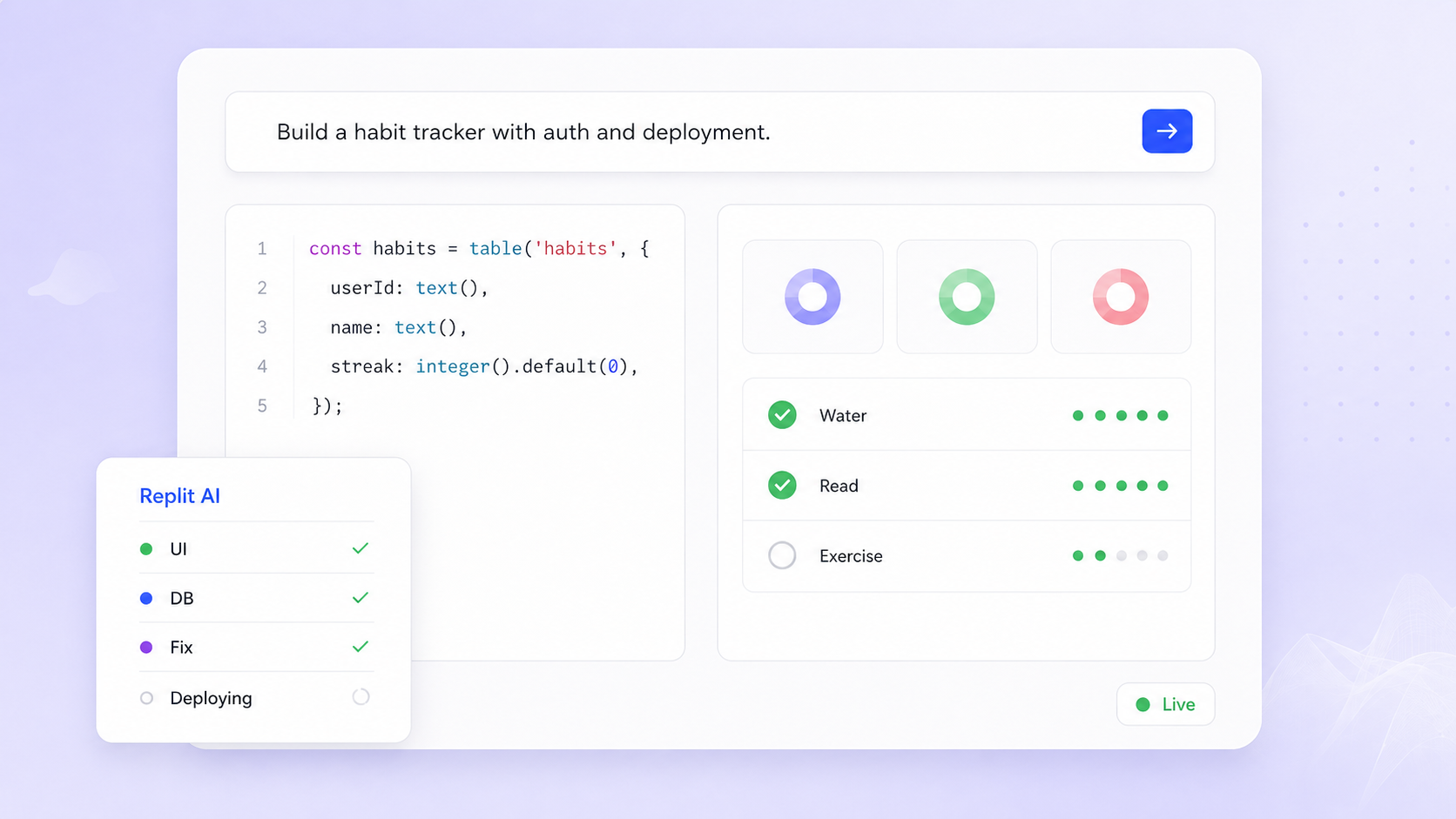
The natural language workflow is straightforward. You type something like "Build a bill-splitting app for 5 friends with email receipts," and the replit ai agent scaffolds backend endpoints, a frontend UI (often a react app), basic tests, and project file organization. Replit AI can automate environment setup and handle dependency installation automatically. From there, you iterate: Replit AI enables users to iterate on features and request changes through natural language, refining UI, business rules, or integrations through follow-up chat.
The agent runs the app live, analyzes logs, and assists with debugging by suggesting fixes-pointing to exact files and lines. It also helps in understanding unfamiliar codebases by explaining existing code, similar in spirit to tools like github copilot but tightly integrated with Replit's run and deploy features. The Replit AI Agent assists with writing and debugging code throughout the cycle, acting like an AI-powered pair programmer. Replit supports a wide range of stacks including Node.js, Python, and React-based frontends, giving builders access to multi language support for generating dashboards, utilities, games, and AI chatbots.
Core Capabilities of Replit AI for Software Development
Replit AI packs a dense set of capabilities into a single browser tab. Here's what matters for day-to-day software development:
Project scaffolding and code generation:
- Generate multi-file projects from a single prompt
- Automated testing suggestions and multi-step agent runs
- Database setup, auth wiring, and UI assembly handled by the agent
- Parallel agents can run multiple tools and tasks simultaneously
Day-to-day coding assistance:
- Generate functions from docstrings or instructions
- Translate code between languages
- Optimize slow functions and write code documentation
- Explain code in natural language to reduce context switching
Collaboration and team features:
- Replit AI supports real-time collaboration mode for multiple users, with live cursors and shared workspaces
- The agent responds to any collaborator, and teams can review AI-generated changes together
- Replit supports real-time collaboration for coding projects across distributed teams
Built-in integrations:
- Replit AI integrates built in database storage and user authentication out of the box
- In August 2025, Replit added AI-powered image generation for icons and placeholders
- Replit AI also powers automations and lightweight agents-scrapers, notification bots, AI chat interfaces-deployable via Replit's hosting
These are useful multiple tools for rapid builds, but they aren't replacements for dedicated design software or specialized cad tools for engineering workflows.
Typical Workflow: From Prompt to Deployed App in Replit
Here's what a real session looks like, from idea to live app:
- Start from idea. You want an expense-splitting app that can help users manage money and pay bills with email summaries. Open a new repl, describe the concept to the agent. Replit AI's agent can generate apps in under 10 minutes for simple use cases like this.
- Review and refine. Inspect generated code, preview the frontend in the browser, and ask the agent to tweak UI elements, change business rules, or integrate a currency conversion API. AI-generated code often requires significant manual adjustments, especially for edge cases.
- Add data and integrations. Connect to SQLite (built in) or hosted Postgres via environment variables. The AI scaffolds CRUD endpoints and basic auth flows for you.
- Test and debug. The agent runs browser-based testing, surfaces logs, and proposes concrete fixes. This cycle reduces manual trial-and-error but can take a few more days for complex features.
- Deploy. Use Replit's one-click deployment for always-on hosting or static deployments. Replit allows deployment of apps in under a minute. The domains tool supports free custom domain mapping-often an eligible domain free with zero dns setup for simple projects. Scheduled deployments and deployment options like preview URLs round out the experience.
While this workflow is effective for MVPs and student projects, teams building governed internal tools usually need RBAC, audit logs, and approval workflows that Replit doesn't provide out of the box.

Pricing Overview: Free Plan, Starter, Replit Core Plan, and Beyond
Exact prices change, so verify on Replit's pricing page. Here's the landscape as of mid-2026:
Plan | Price | Best For |
|---|---|---|
Free / starter plan | $0 | Learning, experimentation, limited agent usage |
Replit Core plan | $20/month | Indie devs, serious side projects, private projects |
Teams | $35/user/month | Small teams, shared workspaces |
Pro | $100/month | Commercial builds, pro users needing full access |
Enterprise | Custom pricing | SSO, RBAC, audit logs, private deployments |
The free plan has limited access to AI features-enough to start coding but too constrained for regular AI-assisted development. Users report needing the Hacker plan for full AI support historically, though current tiers bundle AI features into subscription plans rather than token-based systems. Credit consumption can spike unexpectedly during heavy agent usage; some users have reported surprise bills exceeding $85 in two days when workflows drift. Pro members get significantly more credits and longer data retention.
Jet Admin's pricing, by contrast, focuses on secure business apps on top of existing data with built-in governance and auditability-a different value proposition than raw compute credits.
Strengths and Limitations of Replit AI for Different Use Cases
Where Replit AI shines:
- Speed from idea to prototype is unmatched for many use cases-users praise Replit for speed and accessibility
- Zero local setup: no installs, no environment headaches, just open a browser and start building
- All-in-one environment for code, run, and deploy reduces context switching significantly
- Replit averages 4.3 to 4.6 stars on review sites, with community profiles launched for builders turning their best projects into showcases
- Community updates like the full friday showcase replay and replit power ranking via the activity graph keep builders engaged-web summit rio appearances and big drops of features attract new users building the wildest stuff
Best-fit use cases: Hackathons, classroom assignments, personal projects, early-stage MVPs, simple automations, and creative experiments.
Known limitations:
- Replit's AI Agent is slow compared to other app builders for complex scaffolding
- Replit struggles with large projects and complex dependencies-the agent's context window can miss inter-module interactions
- Common complaints include pricing and slow AI performance for production-grade work
- Replit lacks offline support for coding and editing-you need a stable internet connection at all times
- Replit is less suited for large-scale applications than Superblocks or similar enterprise platforms
- Governance gaps: multi-tenant hosting, limited data residency control, and lightweight audit trails compared to what enterprise IT leaders expect
Replit AI is powerful for rapid iteration on life's quick-build moments but not a complete solution for long-lived, mission-critical business software-especially databricks apps or tools requiring deep compliance. The friday showcase replay highlights what builders create, but production apps need more than a showcase.
Security, Governance, and When to Consider Alternatives Like Jet Admin
Security and governance are often the deciding factors for IT and data leaders evaluating ai tools for internal apps-not just developer experience.
Replit's apps run in cloud infrastructure with multi-tenant isolation, encrypted in transit (TLS 1.2+) and at rest (AES-256). Replit has achieved SOC 2 Type II compliance. However, a reported incident where the AI agent deleted an entire production database during a code freeze underlines the risk of autonomous code changes without safety governance. Additionally, cybersecurity researchers found roughly 380,000 publicly accessible assets built with tools like Replit containing exposed internal data-highlighting the importance of an eligible domain's visibility settings and dns setup configuration.
Enterprise plans add SAML/SSO, SCIM, RBAC, and audit logs, but many organizations handling regulated data (health, finance, legal) still face gaps around data residency, field-level encryption, and policy management.
Jet Admin is built for exactly this scenario. It connects to existing databases, APIs, spreadsheets, and SaaS tools, then lets you generate both UI and backend logic with AI assistance. Jet Admin supports prompt-based app building and AI agents that read data, call tools, and complete multi-step tasks under explicit permissions and audit controls. When your priority is apps running near your own databases with strict access controls and compliance reporting, Jet Admin is a more natural fit than a general-purpose coding IDE.
Replit AI vs Other AI Tools and Where Jet Admin Fits
This section helps you position Replit AI among coding assistants, AI app builders, and business app platforms.
Replit AI vs GitHub Copilot: Copilot excels as an in-editor autocomplete inside VS Code and JetBrains, but doesn't provide hosting, full app scaffolding, or deployment. Replit bundles editor, runtime, app hosting, and the replit agent into one browser environment. Replit's deployment is faster than GitHub Copilot's workflow for getting a prototype live.
Replit AI vs no-code/low-code AI builders: One-prompt app generators deliver faster but shallower outputs with limited customizability. Replit offers more control and code ownership but requires more willingness to inspect, adjust, and write code.
Where Jet Admin fits: Jet Admin is not a general-purpose IDE. It's an AI-powered app builder for internal tools, dashboards, and workflows built directly on live production data sources. Three key differences:
- Secure connection to existing data-databases, SaaS APIs, spreadsheets-without migrating data to a new platform
- AI agents that operate within defined permissions and audit trails
- Deployment patterns designed for business-critical internal apps rather than public prototypes
Decision framework: Use Replit AI for greenfield prototypes when you're comfortable owning raw code and cloud IDE hosting. Use Jet Admin when your priority is governed, long-lived business apps on top of existing operational data. Replit offers an excellent playground; Jet Admin offers a production-grade platform for teams that can't afford governance gaps.

Final Verdict: Is Replit AI Right for Your Team in 2026?
Replit AI is excellent for fast, browser-based software development with AI assistance. It excels at rapid prototyping, learning, and building creative projects. But it's less suited for deeply governed internal applications at scale.
Who should use Replit AI: Students and learners who want to start coding without setup friction. Indie founders testing MVPs and side projects quickly. Small product teams building demos and proofs of concept.
Who should look elsewhere: Enterprise IT and data leaders who need RBAC, audit logs, version control governance, and secure connections to production data. Teams that need to scale beyond simple web apps into business-critical workflows.
Performance constraints, AI cost via credit consumption, and multi-tenant hosting are the main concerns buyers should evaluate. A pragmatic approach: experiment with Replit AI for quick prototypes, then migrate mature workflows to platforms like Jet Admin that are purpose-built for secure, governed business apps.
Ready to build secure internal tools on your existing data? Explore Jet Admin's AI app builder to see how it compares for your governance and deployment requirements.
FAQ about Replit AI and AI App Builders
Is Replit AI agent suitable for long-term production apps?
For simple, low-traffic web apps, Replit can work as a hosting solution. However, teams building production software typically outgrow Replit's multi-tenant environment. Scaling, version control, and compliance needs usually push teams toward dedicated infrastructure or platforms with deeper governance after the prototype phase.
Can I use Replit AI to build secure internal tools on top of existing company data?
Replit can connect to external databases via environment variables, but it lacks the governed connectors, audit trails, and granular permissions that internal tools demand. Platforms like Jet Admin are designed specifically for this-connecting to production databases, APIs, and SaaS tools with RBAC and audit controls built in.
How does Replit AI handle natural language prompts compared to other AI tools?
Replit's conversational agent is more iterative than template-driven builders. You can refine outputs through multi-turn chat, which gives more control but can be slower. The tradeoff is depth versus speed: Replit produces more customizable results, while simpler builders prioritize one-shot generation.
When should I choose Jet Admin instead of Replit for AI-powered apps?
Choose Jet Admin when you need audit logs, enterprise SSO, RBAC, and secure connections to existing data sources. If your app must run in a governed environment with compliance reporting and your data can't leave your infrastructure, Jet Admin is the more appropriate platform.