
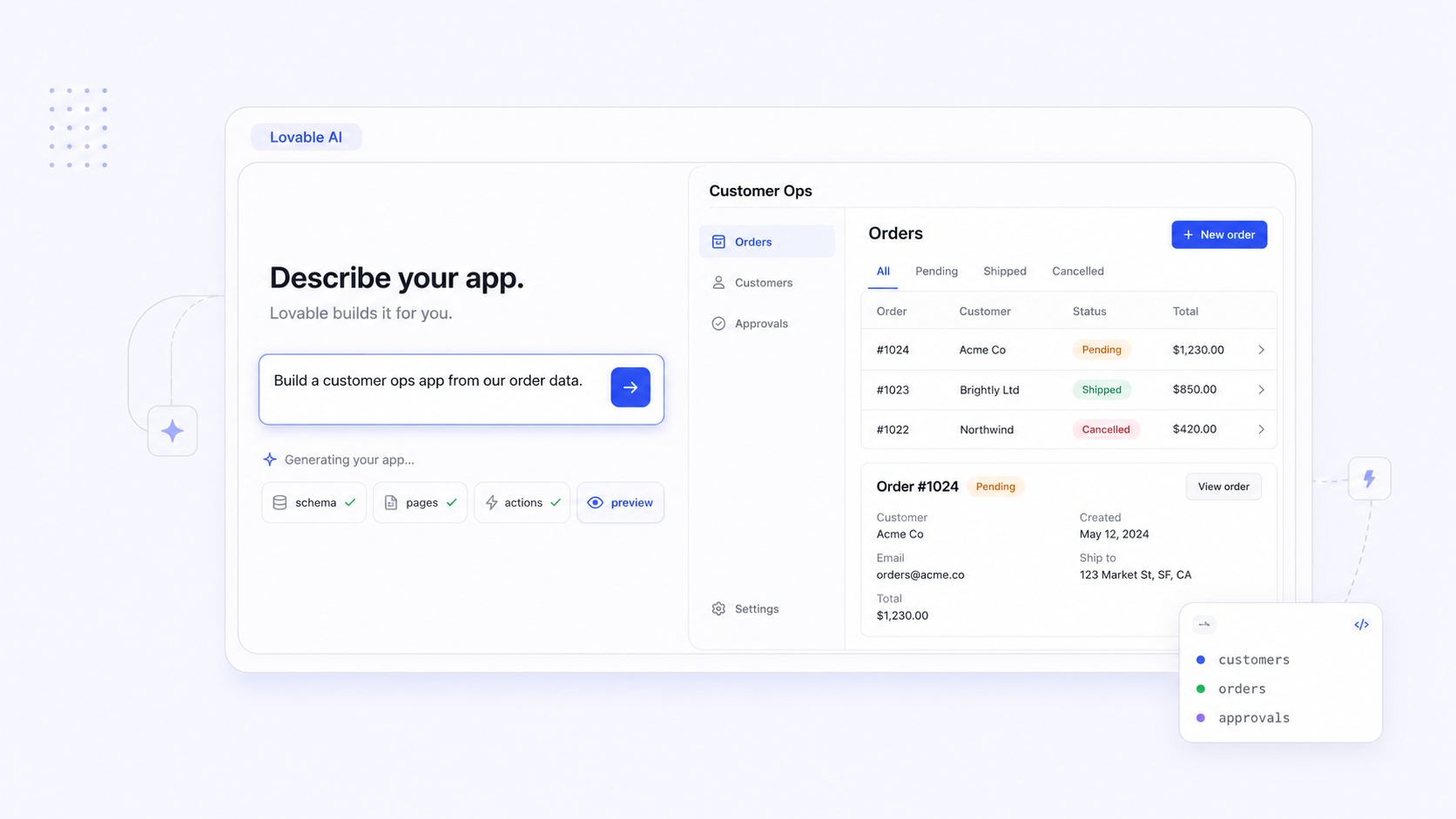
Lovable AI is the embedded AI assistant inside the Lovable platform that lets most users describe an idea in natural language and get working software back in minutes. This article breaks down how it works, what it does well, where it falls short, and how it compares to Jet Admin for building secure business apps on existing data.
Key Takeaways
- Lovable AI is an AI agent inside the Lovable app-building platform that turns natural-language prompts into full-stack web applications, covering frontend, backend, and database functionality. It is optimized for rapidly building greenfield web apps and MVPs, while Jet Admin focuses on secure internal tools and business applications on top of existing data and infrastructure.
- The typical workflow follows a clear path: natural-language prompts generate a codebase and cloud backend, then iterative edits with AI agents refine the project through deployment and monitoring. No-code development reduces reliance on traditional coding, and rapid prototyping allows visualization of product ideas within minutes.
- When comparing Lovable AI to other AI app builders, buyers should evaluate security posture, governance controls, total cost of ownership, app lifecycle management, and how easily non-technical teams can build apps on real production data.
- Lovable AI is a strong fit for fast idea-to-app cycles and new public products. A platform like Jet Admin is better suited for secure business apps with complex permissions and long-term app maintenance over years.
What Is Lovable AI? (Definition, in Plain English)
Lovable AI is the AI development companion embedded in Lovable's builder environment. It is not a general-purpose chatbot. It is an AI-powered platform that enables users to describe applications in natural language and receive a working full-stack app, including UI, data model, auth, and hosting. Conversational intelligence allows natural communication through advanced natural language processing, so a person can type something like "build a SaaS billing dashboard" or "create a customer support portal" and have the codebase, database schema, and deployment scaffold generated automatically.
Lovable AI helps reduce cognitive load for users through intuitive design, abstracting away the complexity of setting up infrastructure from scratch. Formerly known by names linked to "GPT Engineer," the company rebranded in December 2024 and has since attracted millions of builders worldwide.
This article is written from Jet Admin's perspective to help technical evaluators understand where Lovable AI fits in the AI app builder landscape and how it compares to secure business-app platforms like Jet Admin.
How Lovable AI Works Under the Hood
Lovable combines large language models, an AI gateway, and auto-generated infrastructure (Lovable Cloud plus connectors) to manage everything from code generation to deployment. Full-stack capabilities include backend, frontend, and database functionality, all orchestrated through a single prompt-to-code flow.
Here is how the flow works in most cases:
- A user enters a natural-language brief. Natural language generation allows users to input application requirements using text.
- LLMs generate React/TypeScript code and backend logic.
- Lovable provisions hosting, database, and routing via its cloud stack, often using Supabase as a native backend option.
The built-in AI connector is enabled by default, routing requests to different chat, image, embedding, and speech models behind an abstracted gateway. Workspace admins can disable the AI connector entirely if needed. AI gateway usage is measured when making model calls, and rate limits are applied per workspace for AI requests, which helps manage cost and prevent abuse.
Lovable's agent system continuously refines code by running multi-step tasks, applying refactors, and implementing larger changes. Monitoring features include AI activity dashboards and request logs so teams can inspect usage, debug features, and optimize performance over time.
Core Capabilities of Lovable AI for App Building
Lovable AI is designed to help users build apps and websites quickly, from first sketch to production, reducing the need to write boilerplate code manually. Workflow efficiency automates software creation to focus on strategic planning rather than repetitive setup tasks.
Concrete capabilities include:
- Generating new full-stack apps from prompts or URLs ("Build with URL")
- Transforming spreadsheets, CSVs, or uploaded files into working applications
- Building AI-powered experiences like chatbots, coaching apps, and customer support tools
- Adding multimodal features (text, image, speech) via integrated AI models
- Personalization makes each interaction feel tailored and familiar to users
Lovable AI can analyze communication for jargon and create sentiment summaries, which enhances communication tools and improves professional interactions and internal workflows. AI democratization empowers non-technical individuals to create solutions without waiting on engineering backlogs.
The lovable team structure supports shared workspaces where projects, permissions, and building practices are standardized across departments. Auxiliary tools like templates, educational resources (similar to "Lovable Reads" style learning content), and a growing community of examples lower the learning curve for solo builders and organizations.
By contrast, Jet Admin focuses on building secure internal tools, dashboards, and business workflows on existing databases, APIs, and SaaS data, with tighter controls around data access and deployment.

Typical Lovable AI Workflow: From Idea to Deployed App
Here is what a day in the life of building with Lovable AI looks like, using a concrete example: building a referral-tracking dashboard for a sales team.
Step 1 - Ideation and prompts. The user signs into Lovable and types something like: "Build a referral-tracking app for our sales team with email notifications and a simple analytics page." They can upload a sketch or screenshot describing the layout they want.
Step 2 - Initial generation. Lovable AI generates a React-based frontend, backend endpoints, database schema, and auth setup. A working prototype is deployable in minutes, not days.
Step 3 - Iteration with AI. Iterative editing enables modification of applications through conversation with AI. The builder uses chatting or Visual Edits to change layouts, add features, connect APIs, or fix performance issues. AI that respects user agency supports decision-making without manipulating emotions, keeping the user in control. The platform may create subagents to implement larger changes in parallel.
Step 4 - Testing and security. Lovable runs security checks and "Secure vibe coding" routines to catch common vulnerabilities before launch. Users can also sync code with GitHub for external review and debugging.
Step 5 - Launch and monitoring. Deploy through Lovable Cloud, set up a custom domain, and publish. Version history, AI usage dashboards, and Workspace Insights help the team monitor costs, reliability, and adoption week over week.
In contrast, Jet Admin starts from existing data sources. Instead of generating a fresh codebase, it auto-generates secure UIs and workflows, letting teams refine them with AI and configuration for long-term, internal use.

Best-Fit Teams, Use Cases, and When to Choose Lovable AI
Lovable AI maps to specific buyer personas: solo founders, small product teams, agencies, and innovation squads who need to go from idea to live app in days. Lovable AI provides judgment-free companionship for users struggling with social interactions around technical projects, making it approachable even for non-developers. AI characteristics contributing to user comfort include reliability and consistency in how the platform responds to prompts.
Common use cases include:
- Public SaaS products and consumer apps
- AI-powered customer support portals
- Coaching and education platforms
- Marketing microsites and landing pages
- Experimental tools and prototypes for new business lines
Empathy and emotional intelligence enhance user interactions with AI, meaning the platform adapts to how a person works rather than forcing rigid workflows. Cross-functional groups (product, marketing, operations) can co-build and iterate without waiting on a central engineering backlog.
When Lovable AI is a strong choice: you want to validate a new idea, your data and auth needs are straightforward, and you are happy to build and run on Lovable's managed cloud.
When Jet Admin is typically better: you already have production databases, strict compliance requirements, complex role-based access control, or need to embed apps deeply into internal workflows without moving data.
Honestly, many companies will use both patterns: Lovable AI for external, experimental products and Jet Admin for durable internal business apps operating on core systems of record.
Strengths and Limitations of Lovable AI (vs. Data-First Builders Like Jet Admin)
Every AI app builder involves trade-offs around speed, control, and long-term maintainability. Here is a balanced view.
Strengths:
- Extremely fast greenfield development using natural language, with the ability to generate and edit apps in under an hour
- Lovable AI systems foster trust through emotional intelligence and personalized experiences
- Broad creative use cases, from games to industry-specific tools, storefronts, and video landing pages
- Thriving community, templates, and educational content that support continuous learning
- Code ownership and GitHub sync so your project is not entirely locked in
Limitations:
- Opinionated cloud hosting and architecture; organizations wanting everything in their own VPC or on-prem may find a gap
- Complexity of long-term maintenance for heavily AI-generated codebases, especially if ported away from Lovable, can be expensive
- Potential challenges integrating deeply with legacy systems and complex enterprise identity or governance without bespoke engineering
- A recent cybersecurity report found ~380,000 publicly accessible assets built with vibe-coding tools including Lovable, some exposing sensitive data
Jet Admin's strength profile is different: slower to create a net-new consumer app, but stronger for secure internal tools that sit on top of existing databases and SaaS APIs, with fine-grained permissions, audit trails, and long-term app management.
Evaluation checklist for buyers: security posture, data locality, governance, extensibility, and total cost of ownership.
Security, Governance, and Enterprise Readiness
For technical evaluators and CTOs, lovable AI is only one piece of the decision. The bigger question is whether the overall platform meets the organization's security, privacy, and compliance expectations.
Lovable publicly emphasizes proactive security checks, integrations with vulnerability scanners, workspace-level governance, and incident transparency. The platform claims SOC 2 Type II and ISO 27001 certifications. However, buyers in regulated industries should confirm current certifications, data residency options, and deployment models directly with Lovable's security team rather than relying on marketing materials that may change.
Typical enterprise concerns include data residency, model provider transparency (Lovable abstracts which LLMs are used, including models like Claude), source code control, SSO/SCIM, audit logs, secrets management, and how AI agents are constrained by permissions.
A data-first platform like Jet Admin frames security differently: connecting to existing data where it lives, enforcing granular access controls, on-premise deployment options, SAML/SSO, 2FA, and clear auditability for who can run which AI actions on which datasets.
The point here is simple: involve your security and compliance stakeholders early, run a proof of concept, and request up-to-date documentation from any vendor you evaluate.
Pricing and Total Cost of Ownership Considerations
Specific Lovable pricing tiers and credit structures change over time. Always check Lovable's official pricing page for current details. That said, here is the general model as of mid-2026:
- Free plan available at €0 per month
- Pro plan costs €25 per month including VAT
- Business plan is priced at €50 per month including VAT
- Enterprise pricing is volume based with unlimited users
- Students can get up to 50% off Lovable Pro
Credits are consumed per model call, impacted by tokens, images, and audio generated. Free workspaces can view AI activity for the last 24 hours. Paid plans can view AI activity for the last 90 days. Some users report that complexity can rapidly consume credit budgets, making costs unpredictable when you spend heavily on iteration.
Hidden costs buyers should consider:
- Engineering time to productionize and maintain AI-generated apps over years
- Potential vendor lock-in if many apps depend on Lovable-specific infrastructure
- Training and onboarding for teams new to AI-first development
- Migration costs if you need to purchase and manage your own hosting later
Jet Admin follows a different cost profile: fewer greenfield public apps, more focus on consolidating internal tools and reducing spend on multiple SaaS systems, which can offset license costs. Buyers should model 12–24 month TCO scenarios for each platform, including subscription, infrastructure, engineering time, and support, rather than looking only at headline per-seat pricing.
How Lovable AI Compares to Jet Admin for Secure Business Apps
Lovable and Jet Admin sit in overlapping but distinct categories. Lovable AI is optimized for AI-first software creation including public products. Jet Admin focuses on secure internal business apps that sit on top of existing data sources.
Key differences across dimensions:
- Data strategy: Lovable Cloud and generated backends vs. connecting to existing databases, APIs, and spreadsheets in Jet Admin
- App types: External SaaS and consumer apps vs. internal dashboards, workflows, CRMs, and operational tools
- AI usage: Agentic code generation in Lovable vs. AI-assisted UI and workflow generation with safe data access in Jet Admin
- Governance: Workspace and project governance vs. fine-grained permissions on data models, operations, and audit logs
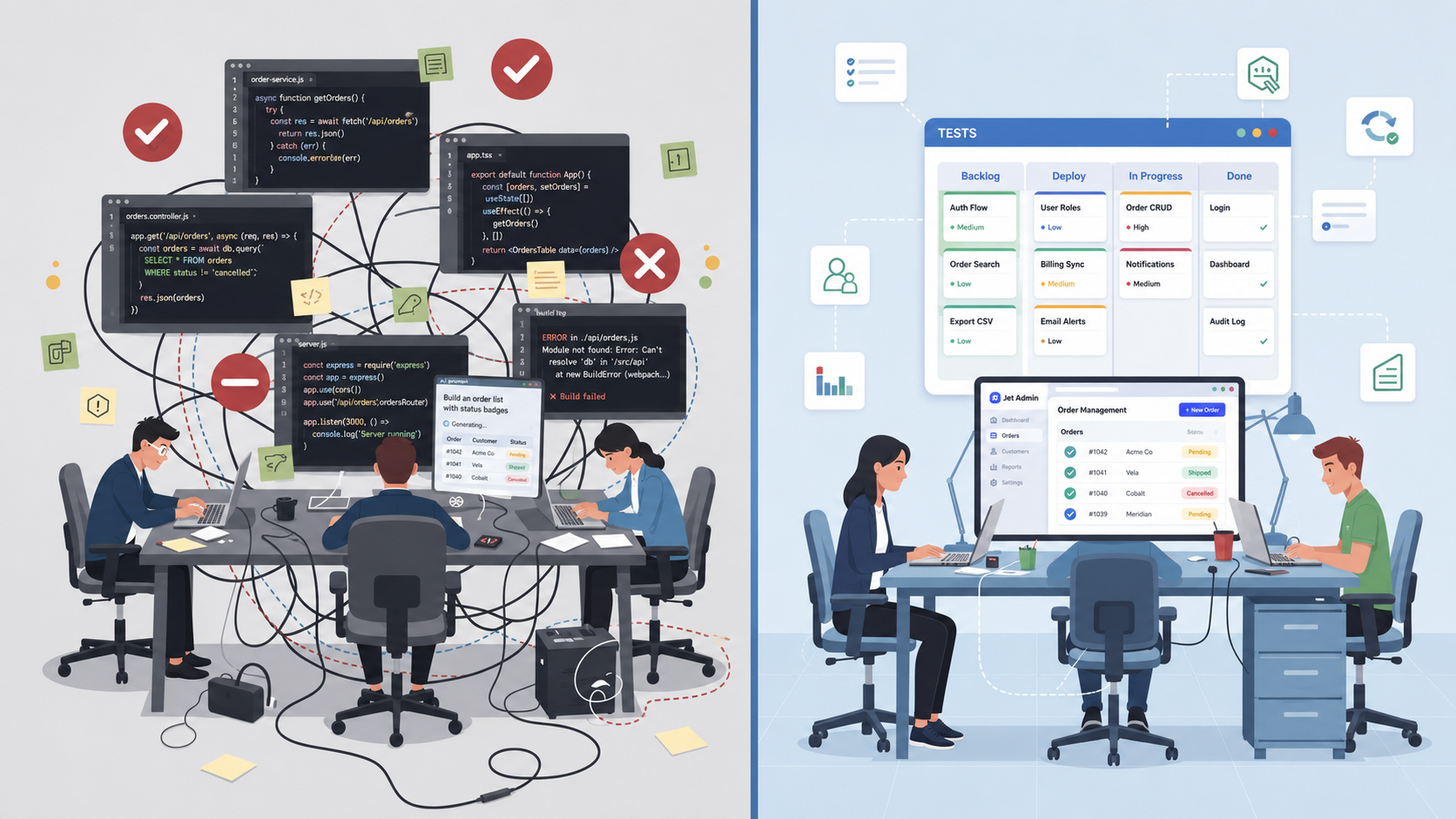
Non-technical teams experience each differently. In Lovable, they describe what they want and the platform builds from scratch. In Jet Admin, they connect to live data, pick templates, and use prompts and configuration to assemble secure interfaces.
Jet Admin does not aim to replace Lovable for building entirely new SaaS products. It offers a more controlled way to build and operate internal tools, admin panels, and reporting apps on existing systems. Many organizations divide responsibilities: innovation teams experiment with Lovable AI, while operations, finance, and compliance-focused teams standardize on Jet Admin.
FAQs About Lovable AI and Secure AI App Builders
Is Lovable AI suitable for strictly regulated industries?
Suitability depends on verified certifications, data residency guarantees, and whether regulators in your world allow use of shared cloud infrastructure. Because official security documentation can change quickly, request current attestations directly from Lovable and run a focused security review before using it for healthcare, finance, or government workloads. Do not assume compliance based on marketing comments alone.
Can I move a Lovable-built app to my own infrastructure later?
Lovable emphasizes code ownership, and you can sync your project with GitHub. However, moving off the platform may require engineering work to recreate cloud services, deployment pipelines, and integrations that were previously managed by Lovable. If long-term portability is a core requirement, test the export and migration scenario early rather than discovering the effort at scale.
How does Lovable AI handle my existing company data?
While Lovable supports integrations with services like Google Workspace and can connect to external APIs, it is primarily designed to generate new full-stack apps. Contrast this with Jet Admin's data-first model, where apps are intentionally built on top of existing databases, data warehouses, and SaaS tools without duplicating data. If your priority is to build on data that already lives in production systems, a data-first approach may be a better fit.
What skills does my team need to be productive with Lovable AI?
Non-technical builders can get far using natural-language prompts, templates, and visual editing. However, organizations see better long-term results when they pair these builders with at least one developer or technically fluent person who understands version control, security basics, and how to reason about AI-generated code. This combination ensures that what gets shipped is maintainable and secure, not just fast.
Can we use both Lovable and Jet Admin in the same organization?
Many companies benefit from a hybrid stack: Lovable AI for rapidly prototyping and launching customer-facing or experimental products, and Jet Admin for secure, long-lived internal tools and dashboards on top of core data systems. The key is clear governance over which platform is used for which category of app, so you avoid duplicated effort and maintain consistent security standards across the organization. Join the growing number of teams that match the right tool to the right job.
If you are evaluating AI app builders and your priority is secure business apps on existing data, try Jet Admin to see how it handles your stack. Connect your databases, review the governance controls, and decide for yourself whether a data-first approach fits your story better than generating everything from scratch.